
A practical holiday shopping guide for home bakers—and the nut shops helping them choose.
You are standing at a nut and dried-fruit shop with a pecan pie on your holiday menu. The halves look handsome. The pieces look convenient. Does buying the less photogenic bag mean compromising the pie?
The useful question is what each nut needs to do in your recipe. A topping and a filling can ask different things of the same ingredient. Here is how to turn that distinction into a shopping list, without buying two full quantities when you only needed one total.
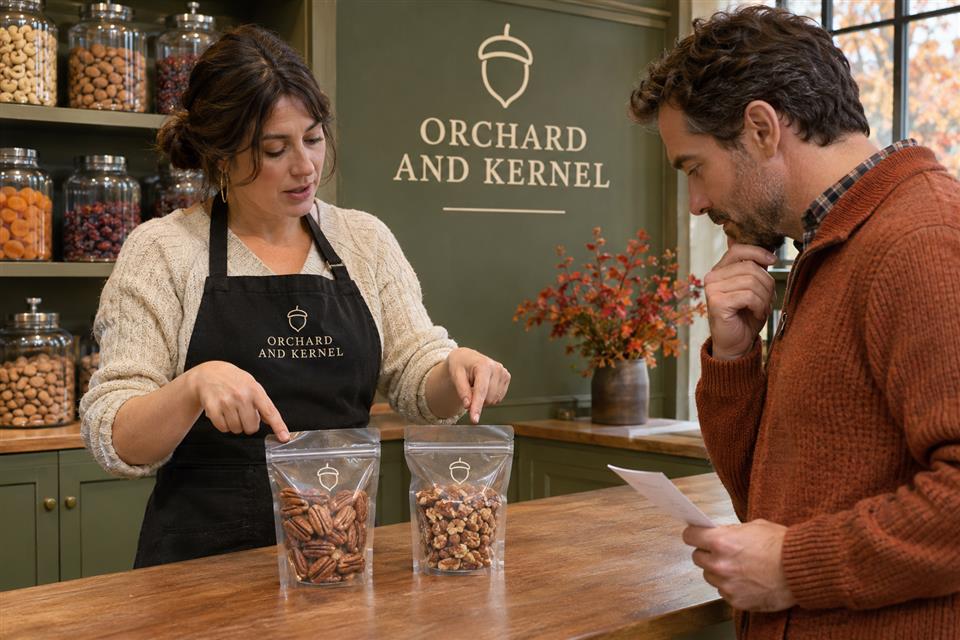
Pecan halves, pieces and meal serve different purposes
Halves: keep the shape when the surface matters
A pecan half is a recognizable portion of the shelled kernel, not a nut still inside its shell. It gives you a visible shape to arrange when the recipe calls for a decorative top. Halves also come in different sizes, so “halves” alone does not tell you how large each one will be.
You can chop halves for a recipe that needs chopped pecans. The reverse is the practical limitation: a packet of small pieces will not give you intact halves for an arrangement. If your recipe uses both, buying halves and setting aside the topping portion first is one possible shopping approach; separate bags may be more convenient when the shop offers suitable quantities.
Pieces: choose the actual size, not just the name
Pieces are useful when the recipe asks for chopped pecans distributed through a mixture. Berdoll’s pecan pieces description, for example, points to cookies, muffins and breads as mix-in uses. That is a useful illustration of the role, rather than a rule that halves cannot be used in those foods.
Check how chunky the pieces actually are. Millican’s wholesale size guide distinguishes halves by counts per pound and pieces by screen size. Another seller may organize its range differently. A photograph or a look at the actual packet is more helpful than assuming that every shop’s “medium” is identical.
Meal: much finer than a bag of chopped nuts
York Pecan’s sizing comparison separates pecan meal, chopped small pieces and medium pieces. Meal is a fine product, not simply another label for the chunky pieces you can see in a pie filling. If your recipe specifies chopped nuts, do not pick meal just because it is also sold in the baking section. Follow a recipe written for that ingredient if you want to use it.
Check roasting and flavor separately from size
The American Pecan Council’s buying guide describes shelled pecans as halves or pieces and also distinguishes raw, roasted, salted and flavored options. Its October–December holiday availability context makes this a useful seasonal shopping question, although pecans are available year-round.
A bag can therefore have the right shape and still be a different ingredient from the one your recipe intends. Honey-roasted halves are not the same purchase as plain halves. Ask the seller which product matches the recipe’s stated form and preparation. If that detail is unclear, check the recipe author’s notes before replacing it with a snack mix or a seasoned variety.
Bring the recipe on your phone. “I need chopped pecans for this filling and halves for this topping” gives the shopkeeper something specific to work with. It is more useful than “I need the best pecans for baking,” which leaves the intended job unknown.
A real shopping-list example: count the filling and topping once
King Arthur Baking’s Pecan Pie recipe lists 57g of chopped pecans and 113g of pecan halves. Its method uses the chopped nuts in the filling and the halves on top. This is one specific recipe—not a standard amount for every pecan pie.
Keep the two roles on your list: 57g chopped for the filling; 113g halves for the top. The 113g topping is already part of the 170g total, not an additional quantity to add again.
If buying halves to cover both roles, you would need enough by weight for the full 170g, with the topping portion reserved before preparing the chopped portion. If buying two forms, compare the shop’s net packet weights with the separate amounts. Actual package sizes determine whether either approach leaves you with extra nuts.
Use the complete source recipe for its preparation and baking instructions. This example explains purchasing arithmetic; it does not test a substitution or adapt the recipe. If your own recipe gives cups, follow its stated form and measuring instructions. Do not borrow a cup-to-weight conversion from a differently chopped or differently packed product.
Two shoppers, two sensible purchases
Leah wants the arranged top shown in her recipe
Leah brings the King Arthur ingredient list. She wants both the chopped filling and the visible halves. The seller confirms a plain halves product that matches her recipe’s requirements; its packet contains enough for the 170g combined total. She chooses that packet and notes the two portions separately. She does not also buy a second full bag of pieces just because the list uses the word “chopped.”
If the available packet were too small, she would need another suitable quantity. If only flavored halves were available, she would check an alternative source or the recipe author’s guidance rather than assume the coating makes no difference.
Owen’s cookie recipe asks for chopped pecans only
Owen is not making a decorative topping. He checks the packet’s visible pieces against the size described in his recipe and confirms the product is the plain form he needs. He buys enough pieces by the recipe’s quantity and the packet’s net weight. He passes on the more elaborate halves display because intact shapes add nothing to his stated plan.
If the pieces were much finer than requested—or the product were actually meal—he would ask for another option. The right purchase follows the recipe, rather than a general ranking of halves above pieces.
Leah and Owen are fictional examples, not customer testimonials or tested baking comparisons.
Questions customers ask before buying pecans
Do I have to use halves for pecan pie?
Follow your chosen recipe. Some use chopped pecans, some use halves, and some divide the nuts between filling and topping. Halves give you recognizable shapes to arrange; they are not a requirement for every pie. In a November 2025 baking discussion, a shopper wondered whether halves were necessary for presentation, and commenters described different preferences. That discussion identifies a real question, not proof that switching to pieces will solve every slicing problem.
Can I use pecan meal instead of pecan pieces?
Do not treat them as equivalent just because both come from pecans. Meal is much finer, while chopped pieces retain visible chunks. Choose the form specified by your recipe, or find one developed for meal. A shop’s product photo can clarify texture, but it cannot validate a recipe substitution.
Are pecan pieces always the cheaper choice?
Check current prices for comparable products. Compare the same net weight, plain or flavored preparation, and the amount you will actually use. A lower packet price can simply mean a smaller packet. Neither the word “pieces” nor “halves” guarantees a better deal, and buying a larger quantity is not a saving if it exceeds your plans.
For nut shops: answer the ingredient question before the checkout pitch
A clear shelf label and a brief staff explanation may be all a shopper needs. Identify the form, actual preparation and net quantity accurately. Ask what the recipe calls for before recommending the most impressive-looking bag. A printed recipe comparison is useful only if its quantities and source remain correct; a verbal explanation can work just as well.
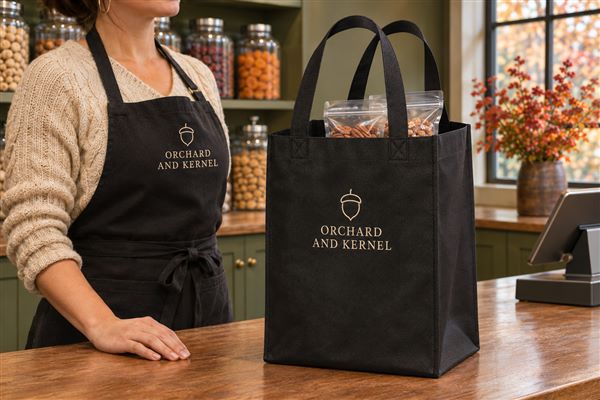
A branded outer bag for a multi-packet purchase
Once the ingredient choice is settled, an optional outer tote can carry already sealed retail packets. DecentCustom’s custom non-woven grocery bags list 80GSM polypropylene, a structured open main compartment, reinforced handles and a 5 × 8-inch imprint area. The listed bag dimensions are 13 × 15 × 10 inches.
Check packet fit, the current customization options and the final artwork before ordering. Keep the logo within the supported imprint area. The bag is an outer carrier in this example, not a replacement for the nuts’ own packaging.
Compare other custom grocery bags, or explore custom products from DecentCustom for your shop’s branding needs. Use the purchase conversation to help the customer choose accurately; branded materials support the shop’s identity after that choice.