
A fresh-pasta shopping guide for hosts planning a holiday dinner or a small gathering.
Ordering for six friends sounds straightforward until one person mentions “100 grams each,” another recommends a pound, and the recipe starts with flour and eggs. Those numbers may describe different things. Multiplying the wrong one by your guest count gives you a precise answer to the wrong question.
This guide focuses on buying fresh Italian-style pasta from a shop, rather than making dough or estimating every type of noodle. The aim is a clear order you and the seller can read back together.
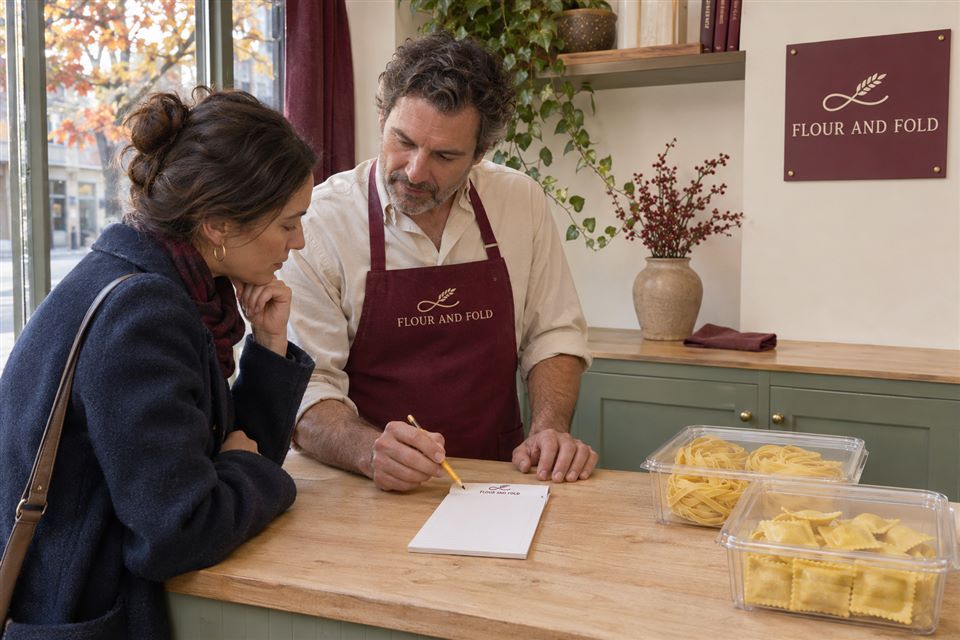
First, establish what “one portion” means
Ask about the product being sold
A weight for fresh ribbons need not be the right weight for ravioli. On its own product page, Dave’s Fresh Pasta recommends one-third of a pound per person for its fresh pasta cuts and one-half pound per person for its ravioli. The difference matters more than memorizing either number: identify the product before applying the serving advice. These are that shop’s recommendations, not a universal rule for every maker.
Ask: “Does that amount refer to this uncooked pasta as you sell it?” For filled pasta, clarify that you are discussing the whole filled product. A count of ravioli also needs context because pieces differ in size. “A dozen” tells you the number of pieces, not automatically the number of diners.
Describe the rest of dinner
Is pasta the center of the meal, or a small first course before another dish? Are you serving one pasta or offering two? Tell the seller what you intend. Mississippi State University Extension’s pasta notes distinguish portions by pasta type and the role of the course. Its recipe-specific cup guidance should not become a universal conversion for a shop’s different shapes and packages.
A second example comes from Pasta Pantry’s Canadian fresh-pasta menu, which gives a larger amount for a main than a side. That reinforces the importance of the meal context; it does not establish a US serving standard. Your own guests’ appetites and the shop’s actual product still matter.
Keep flour, uncooked pasta and cooked food separate
Flour is an ingredient used to make dough. A finished uncooked pasta product can also contain other ingredients; a filled pasta includes its filling. A flour quantity from a homemade recipe is therefore not a retail order weight to transfer directly to the counter.
This confusion appears in a November 2025 discussion about fresh pasta for ten guests: the host asks about a per-person amount while also considering flour and eggs. Replies ask what type of pasta and whether it is a first course or the main meal. The useful lesson for a shopper is to name the unit before calculating. The thread is one person’s question, not evidence for a population-wide portion size.
Prepared catering food is another category. Fatto a Mano’s catering page discusses portions within its prepared menu and explains that orders can be consolidated into larger containers. That is a different ordering conversation from buying uncooked pasta by weight. Do not apply a catering “portion” number to a retail pasta packet without clarification.
Turn the agreed amount into a package count
Use this sequence: guest count × the agreed amount per person = the total for that product. Then compare that total with the actual net package weight. Keep all weights in the same unit.
A fictional package calculation—not a serving recommendation
Suppose your shop has recommended 160g of a particular uncooked pasta per guest for your menu. You have six guests, and that product is sold in 250g packs.
6 × 160g = 960g requested.
3 × 250g = 750g, which is below that amount.
4 × 250g = 1,000g purchased, leaving 40g above the agreed total.
The 160g recommendation and 250g pack are invented inputs to demonstrate the arithmetic. Replace them with your seller’s advice and the real product label. The calculation cannot decide how much your guests will eat.
If the shop sells by weight, ask whether it can supply the agreed total. If it sells fixed packs, confirm the pack count and resulting total. Extra food should be an intentional choice, rather than an unnoticed consequence of rounding or mixing units.
Two dinner plans that lead to different orders
Nora orders one pasta as the main course
Nora has six guests and chooses one fresh ribbon pasta. She tells the shop it will be the main dish and describes the sides. Using the hypothetical inputs above, she accepts four 250g packs after checking that the total is 1,000g of the uncooked product. Her note records the pasta name, six diners, main course, four packs and the total weight.
She does not add a second identical order because a recipe mentions flour. If the seller’s recommendation or the available pack size changes, she recalculates before confirming.
Ben offers two pastas within one course
Ben also has six guests, but wants both ribbons and filled ravioli. He tells the seller that everyone will sample both within the same course. He asks for an agreed split across the two exact products, with a separate uncooked weight for each. He confirms those two amounts as the order.
He does not silently assign a full six-person order to each pasta. Nor does he assume a half-weight split works equally for ribbons and filled ravioli. If he actually wants two generous full courses, he says so; that is a different menu. If the shop cannot advise on the combination, he can simplify to one pasta rather than invent a conversion.
Nora and Ben are fictional ordering examples, not customer testimonials or tested dinner results.
Questions to settle before you pay
Can I use the same weight for fresh and dried pasta?
Do not carry over a number without checking what the recipe or seller means. Confirm the exact product, whether the quoted weight is uncooked, and the intended course. If adapting a recipe, use the author’s guidance for that substitution. A familiar dried-pasta portion is not automatically the correct purchase weight for a different fresh product.
Does “100g of flour per person” mean I should buy 100g of fresh pasta?
No. That describes a dough ingredient, not necessarily the weight of finished uncooked pasta being sold. Ask the shop for its recommended quantity of the actual product. Keep homemade recipe quantities on a separate list from the retail order so flour, eggs, filling and pasta are not accidentally counted as the same thing.
Should I order a full portion of each pasta if I serve two varieties?
Explain whether the two varieties share one course or form separate courses. Ask for the amounts of each product within that plan. Ordering a full guest-count quantity of both can be intentional, but it should not happen just because the two products occupy separate lines on the order. Read back both quantities before confirming.
Finish the order with the details numbers cannot answer
Confirm the exact shape or filling, total uncooked quantity, packaging, sauce inclusion if any, and the pickup arrangement the shop actually offers. For a holiday gathering, ask about current availability and ordering deadlines; there is no single cutoff that applies to every pasta shop.
Choose a sauce for the pasta you have selected, rather than using sauce preference to guess how many people a packet feeds. Eataly’s shape-and-sauce guide offers pairing ideas, including lighter accompaniments for filled pasta. Your shop can help with its specific filling and sauce options. Pairing advice and quantity confirmation answer different questions.
For pasta shops: give the customer a clear reminder
A standard order confirmation, a phone note or plain paper may already be enough. Record the product, the amount and its unit together. If you write “four packs,” add the pack size and total weight so that the customer can understand the order later. Keep a planning reminder separate from the shop’s official order confirmation and product instructions.
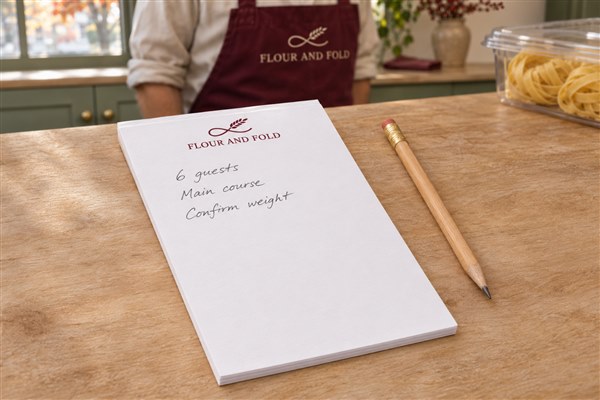
Optional branded paper for the conversation
DecentCustom’s custom adhesive notepads list a 4 × 6-inch paper size, 25 blank sheets and an adhesive strip behind the top. A modest logo header can leave room for handwritten reminders on a dry counter.
Check the current artwork options and proof before ordering. This example uses a logo and handwriting; it does not promise that a printed worksheet is included. Keep the paper separate from food and its packaging instructions.
Explore custom notepads and notebooks or other custom products from DecentCustom when planning your shop’s branding. The practical priority is the same with any stationery: customer and seller should agree on the product and quantity before the order is placed.