
A label-reading guide for shoppers buying Korean ingredients at an international grocery store.
The names look similar on a shopping list. Both products are red, and both appear in Korean recipes. At a busy international grocery store, that can be enough to put the wrong item in your basket—especially when a bag of visible flakes is labeled “powder” in English.
You do not need to memorize an entire pantry before shopping. Bring one recipe, identify which ingredient it asks for, and check a few specific details on the package. Here is what to look for.
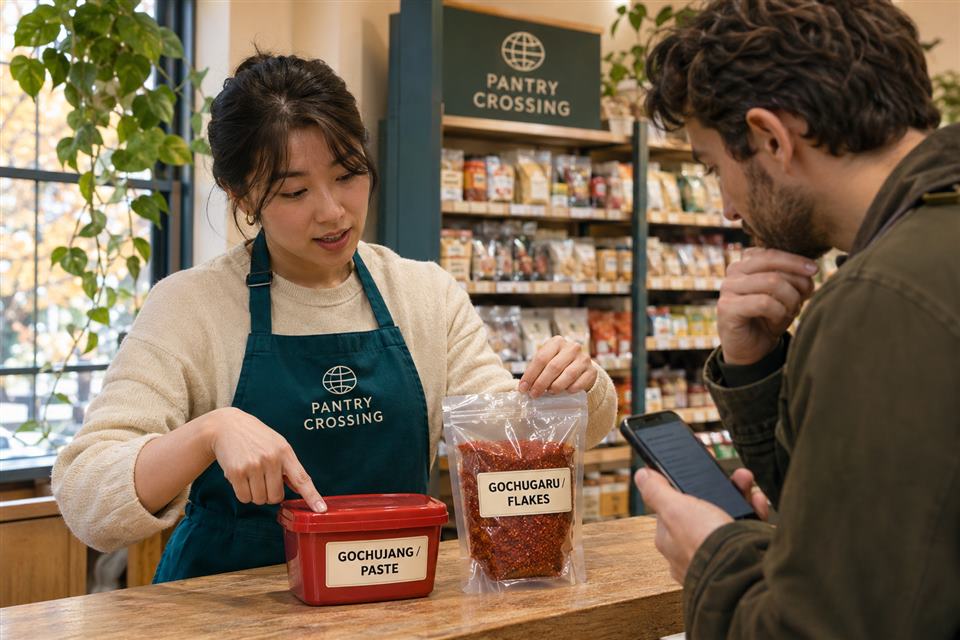
Start with the form: paste or dry pepper?
Gochujang: a seasoned paste
Korean Bapsang’s pantry guide describes gochujang as a sticky red chili paste with savory, sweet and spicy characteristics. It is not simply ground chili mixed into a convenient shape: the paste brings other ingredients and flavors to a dish.
For a concrete product example, Sempio’s Classic Hot Pepper Paste lists rice, corn syrup, red pepper powder, salt and soybean among its ingredients. That is the maker’s description of this product, not a promise that every gochujang has the same formula. Read the actual package you intend to buy.
Gochugaru: dry pepper, with different grinds
Gochugaru can be sold as coarse flakes or a finer powder. My Korean Kitchen’s ingredient guide distinguishes those forms and explains that their uses differ. If your recipe specifies coarse flakes, the word “gochugaru” alone does not finish the shopping decision; check the grind too.
This is also why a recipe may mention dry pepper separately from paste. If your ingredient list names both, keep them as two separate items rather than crossing one off because you found the other. Follow that recipe’s quantities and instructions.
“Powder” on the front does not always mean finely ground
Maangchi’s buying notes for hot pepper flakes show the source of a common misunderstanding: an English label can say “Red Pepper Powder” even when the contents are coarse flakes. Look for an additional word such as “coarse,” a clear product description, or the visible texture where the packaging allows it.
A current retail example is H Mart’s Coarse Red Pepper Powder listing, which identifies the product as gochugaru and describes a coarse grind. The English word “powder” is therefore not enough by itself to decide whether a bag matches a recipe asking for flakes.
Gochujang — Korean hot pepper paste.
Gochugaru — Korean red pepper flakes or powder; check coarse versus fine.
Then add your recipe’s exact wording or a picture of the ingredient it specifies.
If the package is opaque or the English wording is unclear, ask a staff member to help identify the product. Show the relevant ingredient line, not just the finished-dish photograph. A bowl of red stew cannot tell them which of several red seasonings the recipe author used.
Check whether the product is base paste or a prepared sauce
The word “gochujang” can also appear in the name of a sauce that uses it as an ingredient. For example, Sempio’s Gochujang Bulgogi Sauce is described as a ready-to-use sauce made with gochujang as a base. It is a separate product from the company’s Classic Hot Pepper Paste.
If your recipe asks for gochujang and then adds its own seasonings, check that you are buying the intended paste rather than a prepared sauce. If your plan is to use a ready-made sauce instead, follow that product’s directions. A shared ingredient name does not make the two packages equivalent in the original recipe.
Container color is a shortcut, not a product description. Read the name and ingredient information on the exact item. The red tub in our illustration helps show a paste, but it does not establish a color code for every manufacturer.
Two shopping trips, with the uncertainty resolved
Maya needs coarse gochugaru
Maya’s recipe explicitly asks for Korean red pepper flakes. At the store, she finds a bag labeled “Coarse Red Pepper Powder.” She checks the additional description and can see coarse flakes through the packaging. Staff confirm that it is the gochugaru form she is seeking. She chooses that bag and leaves the paste on the shelf.
If the available product were fine powder, or nobody could establish the grind, she would check the recipe author’s guidance or look for a clearly identified alternative. She would not buy the paste simply because both products are red.
Alex needs gochujang paste
Alex’s recipe lists gochujang and then several other seasonings. He notices both a hot pepper paste and a gochujang-based barbecue sauce. After reading their descriptions, he selects the base paste that matches the recipe and skips the prepared sauce.
He checks the maker’s stated heat level as a separate preference question. He does not calculate a matching tub from the spoonfuls of flakes he used on a previous occasion. If the item’s identity remains unclear, he asks before purchasing rather than treating the sauce and paste as interchangeable.
Maya and Alex are fictional examples of buying decisions, not customer testimonials or recipe tests.
Questions shoppers ask about the difference
Can I replace gochugaru with gochujang?
Do not assume a direct swap. One is dry pepper; the other is a paste with additional ingredients, flavor and texture. Check whether the author provides an alternative for that particular recipe. If not, finding the requested ingredient or choosing another recipe is more reliable than treating equal spoonfuls as equivalent. This guide does not provide a substitution formula.
Does a familiar amount of gochugaru tell me which gochujang heat level to buy?
It does not establish a dependable match. In an October 2026 shopper discussion, someone who had used flakes and other ingredients instead of paste asked that exact kind of question. The two products differ in more than heat, and the original mixture is not a measurement of the new product. Read the maker’s description of the specific paste; do not infer a universal conversion from tablespoons of flakes to a brand’s heat label.
Is every product called Korean chili powder the same?
No. The wording may refer to different grinds, and English naming can be imprecise. Confirm that it is gochugaru, then check whether it is coarse or fine and whether that is what your recipe specifies. A familiar word on the front is a starting point for checking the product, not the whole answer.
For international grocers: make the form easy to find
Keep the manufacturer’s product label available and accurate. A short shelf note can add a useful distinction—“paste” or “flakes”—without replacing the ingredient information. Staff can then help the shopper check the exact product, grind and recipe wording. An existing shelf label, a plain printed note or a brief explanation may already do the job.
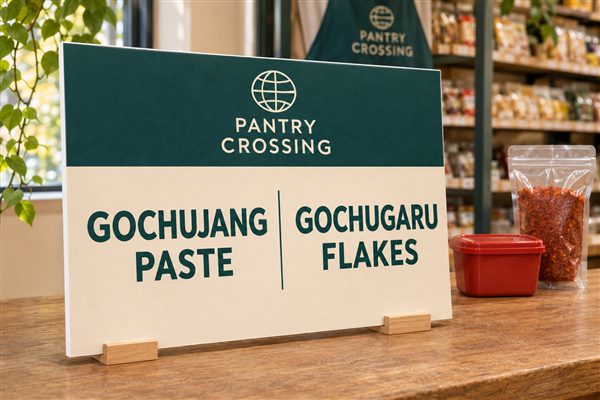
An optional branded comparison sign
For a more permanent indoor display, DecentCustom’s custom foam board signs list 5mm foam, a smooth matte surface and full-color UV printing on one side, with horizontal and vertical options.
A short comparison can keep the two names and forms visible beside the relevant aisle. Confirm the current size and shape options, artwork and support arrangement before ordering. The illustration’s rectangular layout is a proposal, not a supplied holder or a test of how well shoppers understand the sign.
Explore other custom marketing materials or custom products from DecentCustom for your store. Keep the message tied to the actual products on the shelf, and update it when the range changes.