
A practical first-visit guide for shoppers—and the independent markets that welcome them.
A well-stocked market can make dinner possibilities feel endless. That is enjoyable when you know what you want; less so when you are standing in an aisle with a vague instruction to buy “some noodles.” The aim of a first visit can be smaller: leave with the right ingredients for the dish you chose, and a clearer idea of what to look for next time.
This is a real kind of beginner question. In a December 2025 shopping discussion, someone visiting a US Asian grocery store had a pho recipe in mind but still felt overwhelmed by unfamiliar products, translations and brands. One shopper’s experience is not a survey, but it identifies a useful problem: having a recipe open is only the start of making a workable shopping list.

Use pantry guides as references, with their scope in mind
There is no single starter basket that represents every cuisine sold across Asian markets. Start with the food you want to make, then use a resource that explains its ingredients.
RecipeTin Eats’ Asian market shopping list separates frequently used items from dish-specific purchases and connects ingredients to recipes. That connection is more useful than copying the whole list. The article reflects the author’s cooking and Australian shopping context; its prices are not a quote for your local US store.
Feasting at Home’s printable list groups items by store section and explicitly notes that readers probably will not need everything. It also points out that stores differ. Use those categories to organize your own missing ingredients rather than assuming every store carries the same range.
For more focused help, The Woks of Life’s Chinese pantry guide explains a foundation for its Chinese recipes. Just One Cookbook’s beginner page connects Japanese ingredient resources with recipe searches and filters. Maangchi’s Korean ingredient directory organizes ingredients into categories you can explore when a particular recipe names something unfamiliar. These are different starting points, not competing versions of one universal pantry.
Turn the recipe into a “have / buy / ask” note
Read the ingredient list and its linked notes before leaving home. Keep details that change the purchase: the exact ingredient name, fresh or dried form, a specified type, and the amount the recipe calls for. A finished-dish photograph alone will not convey those details to someone helping you.
- Have: check your kitchen against the actual list. Record what you already have in the required type and sufficient quantity. Do not assume a bottle qualifies just because its name sounds similar.
- Buy: copy only the missing items, retaining the descriptions and amounts. Group them into likely sections such as produce, sauces or noodles. Treat those as search categories, not a guaranteed aisle map.
- Ask: flag anything you cannot identify or match. Save the ingredient note or package photograph alongside the recipe link. A question mark is a better reminder than an unsupported guess.
Keep “amount needed for the recipe” separate from “package to purchase.” A recipe calling for a few tablespoons does not mean the shop sells that quantity separately. Check the package size and decide whether you want that purchase before adding it.
A filled example: one recipe, a shorter buying list
Consider The Woks of Life’s 5-Ingredient Lo Mein. Its ingredient list specifies 1 pound of fresh, uncooked lo mein noodles, 3 scallions, 3 tablespoons of neutral oil, 2 tablespoons of light soy sauce and 3 tablespoons of oyster sauce. Those details belong to that recipe; they are not a general noodle-shopping formula. Follow the author’s full directions when making it.
Recipe: the linked five-ingredient lo mein.
Have: the required oil and both sauces, with enough for this recipe.
Buy: fresh, uncooked lo mein noodles—1 pound needed; scallions—3 needed.
Ask: “Can you help me find the fresh, uncooked lo mein noodles this recipe specifies?”
Skip today: unrelated pantry bottles that are not on this recipe’s list.
Jordan finishes the planned trip
Jordan checks the noodle description with staff, chooses the matching product in enough quantity, and gets the scallions. The two sauce bottles at home stay on the “have” list. The basket is complete when the missing ingredients are covered—not when it resembles someone else’s pantry photograph.
Casey encounters a missing item
Casey arrives with a different chosen recipe and its exact noodle description. The available products do not clearly match. Casey shows staff the relevant ingredient note and learns that the requested item is not currently available. Rather than buying a random noodle and several sauces to compensate, Casey checks whether the author provides an alternative. If that remains unresolved, Casey postpones that dish or selects another recipe and rebuilds the list before purchasing.
Jordan and Casey are fictional buying examples, not customer testimonials or recipe tests. Staff assistance and product availability vary by store.
Ask a question someone can answer
“What should I buy?” can lead to a very long conversation. A narrower request gives the person helping you something concrete to work with:
Show the ingredient line and any author-provided package image. Ask where the item is first; if the identity or an alternative remains uncertain, return to the recipe author’s guidance. Do not treat a translation app or a similar-looking package as confirmation of a substitution.
Browsing can still be part of the visit. Finish the planned list first, then decide separately whether you want to explore. Photograph an unfamiliar product for your own next-trip research where the store permits it, or save its name in your notes. You do not have to buy it immediately to learn about it.
Questions first-time shoppers ask
Do I need to buy a complete Asian pantry on my first visit?
No. A broad pantry list is a reference for future cooking. Start with a dish you actually want to make, check what is already at home, and buy the missing ingredients. Expand as you choose more recipes and learn which products you use.
How do I choose among brands I do not recognize?
First establish the required ingredient and type. Then read the recipe author’s buying notes or ingredient guide for product-specific examples, and compare those with the actual packages available. A recommendation for one recipe is a starting point, not proof that every other brand is unsuitable. If the match is still unclear, ask before buying.
What if I cannot find an ingredient or read the package?
Show staff the ingredient line, the required form and any reliable package image. Check any alternative against the recipe author’s advice. If nobody can establish the match, leave that item unresolved and reconsider the dish before buying the rest. A confident guess can still be the wrong product.
For market owners: help the next visit feel familiar
A clear aisle label, a brief explanation or a plain printed note may be enough to help a newcomer finish a list. Keep product names available, and make it easy for shoppers to show staff a recipe. Enson Market’s beginner guide also suggests asking staff for help and bringing reusable bags. Neither requires a special branded kit.
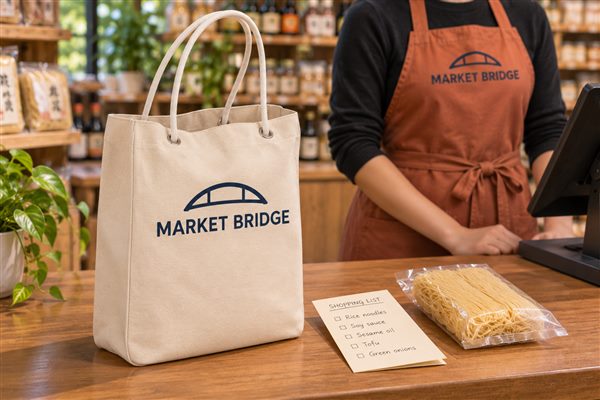
An optional branded carrier for return visits
If your market wants its own bag design, DecentCustom’s custom cotton grocery tote bags list 6 oz. cotton, dimensions of 13 W × 15 H × 4 inches, a solid bottom and 9-inch cotton cording handles.
The natural cotton bag and simple store mark shown here are a proposed design. Check the current product options, artwork and fit for your intended packaged items before ordering. A shopper’s existing bag can also serve the trip; a printed logo is an optional store choice.
Compare other custom grocery bags or explore custom products from DecentCustom when you have a specific use in mind.