
Delicatessens & specialty grocery stores · Ordering sliced meats and cheeses
You know you want ham for a sandwich. Then the person behind the deli counter asks how much, how thin and which ham. None is a difficult question once you know what information the counter needs, but it can feel like a test when you have never ordered this way.
Name the product, give the amount you want—or ask for help choosing an amount—and describe how you would like it sliced. Mention what you plan to use it for when that helps. If you are unsure about thickness, ask whether the employee can show you a first slice before completing the order. You do not need to begin with a slicer number.
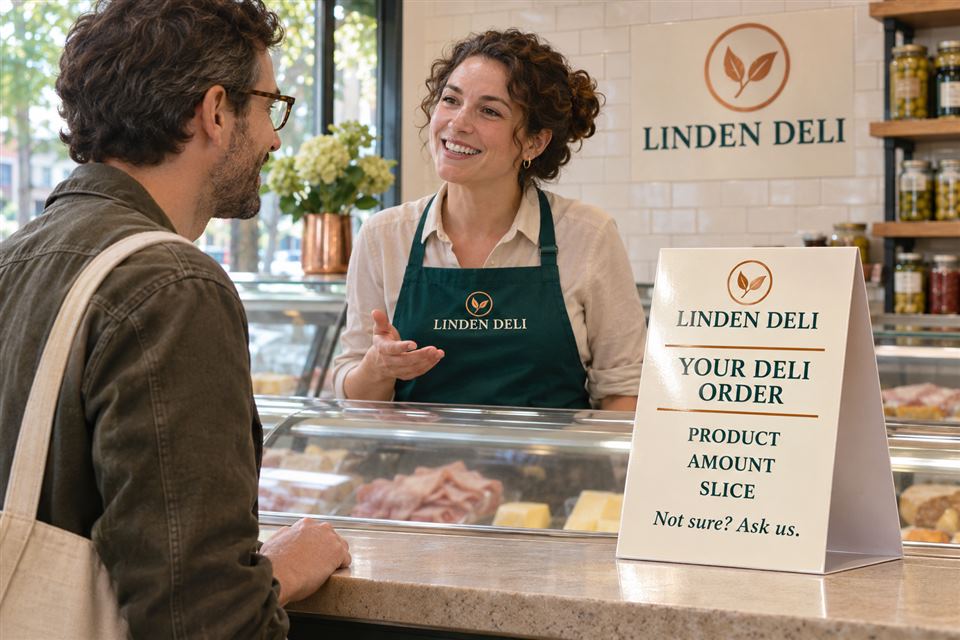
The uncertainty is often about what to say
In a 2025 deli-counter discussion, the original poster says they avoid the counter because they do not know the options or how to ask. They want thick ham and a small amount for themselves. Replies offer different quantities and suggest describing the desired slice or explaining that it is a first visit.
Those are individual accounts with unverified identities and location, not a survey of U.S. customers. The useful point is the communication gap: someone may know the food they want but not the vocabulary or amount to request. An independent deli can help by making the next sentence easier, rather than expecting every shopper to arrive with a complete order.
Build an order from three pieces of information
1. Identify the actual product
Use the name on the case label, including the variety or brand if there is more than one similar choice. “The oven-roasted turkey on the left” is more specific than “turkey” when several products are displayed. Pointing can help, but wait for the employee to confirm which item you mean.
If you are undecided, say so: “I’m choosing between these two. Could you explain the difference?” The answer might be a product description or a recommendation. It does not have to begin with a purchase.
2. State an amount, or explain what you need help deciding
A weight such as a quarter pound or half pound gives a clear starting request at a counter using pounds. These are example amounts, not a required minimum or a promise about sandwich yield. If you prefer to request a number of slices, ask whether that counter can prepare the order that way and how the purchase will be weighed or priced.
When you do not know the weight, explain the use: “I’m making one sandwich and don’t know how much to ask for. Could you suggest an amount and tell me roughly what it would cost?” Check the suggested quantity before agreeing. A family buying for several lunches and one person buying a few thick slices need not start with the same amount.
3. Describe the slice you want
Plain words are useful: thin, very thin, a thicker slice, or slices that hold together for a sandwich. “For sandwiches” gives context, but your preference still matters. Ask to see a first slice if the shop can provide that check, then say “a little thinner,” “a little thicker,” or “that looks right.”
Boar’s Head’s thickness guide uses names including shaved, very thin, thin, sandwich cut and dinner cut. JENNIE-O’s deli guide uses another set of descriptive categories, including medium and super thick. These brand examples help explain choices; they do not establish one compulsory cut for every sandwich or every deli product.
Three complete ways to start the conversation
These are illustrative requests, not actual customer orders, portion recommendations or guarantees that every shop offers each service.
You know the weight and want a thin slice
“Could I have a quarter pound of that oven-roasted turkey, thinly sliced, please? If possible, could you show me the first slice?”
After the employee confirms the product and shows the slice, give a clear response. A nod that the employee cannot see is less useful than “Yes, that thickness, please.”
You know the number of slices you want
“Could I get six slices of the provolone, medium thickness? Can you prepare an order by slice count, and tell me the weight and price?”
The number of slices describes your request. It does not turn a product sold by weight into a fixed-price six-slice pack. Confirm how the shop handles it.
You want thick ham but do not know the amount
“I’d like that ham in thicker slices for one sandwich, but I don’t know what weight to ask for. Could you help me choose an amount and show me the thickness first, if that’s possible?”
Here the missing information is stated openly. The employee can clarify the product, suggest a quantity and explain what is available instead of guessing what “normal” means to you.
If the counter uses slice numbers, ask which number produced the slice you liked and note it with the product name and shop. Di Lusso’s guide publishes its own numbered ranges alongside descriptions. For a repeat visit, a confirmed local reference is more useful than assuming a number copied from another guide will give you the same result.
For deli owners: give customers a helpful starting line
A short counter prompt can invite people to share what they know and ask about what they do not. It need not reproduce a long product menu or present an unverified chart of machine settings.
Example counter-card wording
LINDEN DELI
YOUR DELI ORDER
PRODUCT
AMOUNT
SLICE
Not sure? Ask us.
This fictional card supplies three prompts; staff still complete the conversation. A useful readback is: “A quarter pound of the oven-roasted turkey, thinly sliced—is that right?” If the customer has not chosen an amount, ask about it before treating the order as complete. If a requested option is unavailable, explain the available alternative and let the customer decide.
Keep any invitation to sample consistent with your own service. Publix’s sliced-meat and cheese page explicitly invites shoppers to ask for a sample. That is an example of a retailer explaining its offer, not a policy that applies to every independent shop. A general “Not sure? Ask us” prompt avoids promising a particular service you have not chosen to provide.
Before printing, show the proposed card to someone unfamiliar with the counter. Ask them how they would start an order and what they would do if they did not know the weight. If the card seems to require a number they cannot supply, revise the wording or staff greeting. This is a suggested review, not a completed customer test.
Questions worth answering at the counter
Do I have to know the slicer number?
No number is needed to begin the conversation. Describe what you want, such as a thin slice that holds together, and ask the employee to help. If that shop uses a chart or numbers, have the employee explain the choice and confirm the actual slice rather than guessing from a number alone.
Can I ask for six slices instead of a weight?
Ask whether the shop can fulfill that request and how it will be charged. Slice size and thickness affect the resulting weight, so six slices are not automatically a particular weight or price. Confirm the product, preferred thickness and total with the employee.
How much should I order for one person?
There is no single amount that describes every person’s plans. Say how you intend to use it and ask the deli for a suitable starting quantity and approximate cost. The quarter-pound request above is an example, not a serving standard. You can also ask what smaller quantities the shop can prepare.
A small printed prompt can support the conversation
A handwritten notice or a clear staff greeting may be enough. A reusable branded card is an option when you want the same short invitation visible to each customer. Put it where people can read it while considering an order, and check that reflections or other signs do not hide the words.
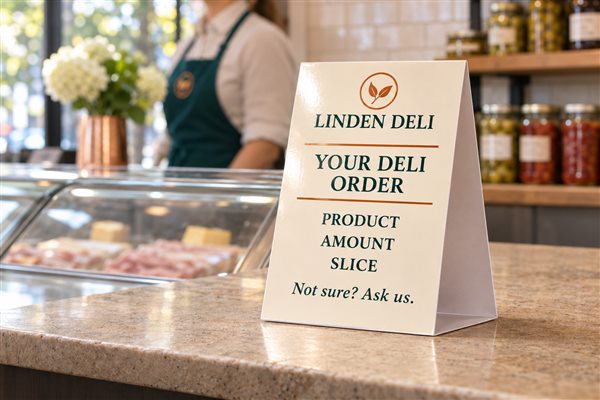
A folded paper format for a concise message
DecentCustom’s custom table tents list a 5 × 7 inch size, 14pt card stock and full-color printing. Glossy is the default finish; the page also lists a matte option.
Confirm the finished layout, fold, selected finish and order quantity before approval. This is a paper communication item, not a washable plastic sign or a food-contact product. The illustrated placement is a dry customer-side counter.
Compare custom marketing materials for other message formats, or explore custom products from DecentCustom after deciding what information your customers need.
The aim is a request the customer understands and the employee can confirm: the right product, an agreed amount and a slice preference made clear. Whether a particular card improves that conversation needs observation at your own counter.