
Farmers market vendors · Booth signs and easier browsing
You are answering a question, packing an order and watching the next person approach. A shopper at the other end of the table wants to know what the carrots cost. If the answer is hidden behind a basket—or behind your current customer—they may have to interrupt just to decide whether to keep browsing.
Let shoppers identify the business from the aisle, identify each product at the display, and find its price with the selling unit. Keep the farm name separate from information that changes during the day. Check the view with people standing at the table, not just when the booth is empty. A legible handwritten card can do the job.
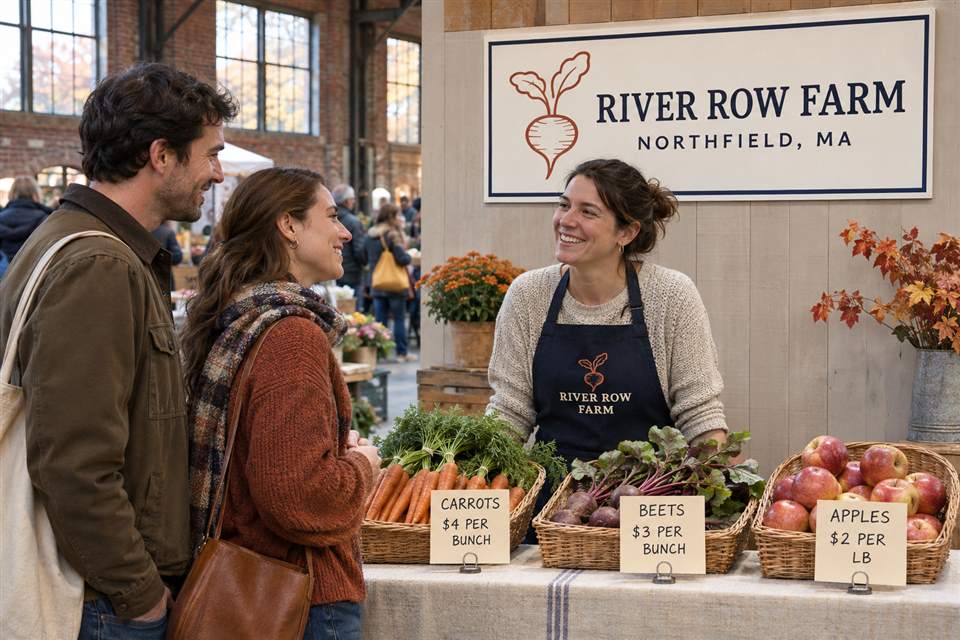
A price question can be a browsing barrier
In a San Diego farmers market discussion, one shopper describes choosing a plant seller with visible prices because they could plan what to buy without asking. A self-described former produce vendor adds an important counterpoint: people still asked about prices even when a chalkboard was present, and answering was part of serving customers.
That 2022 discussion is a qualitative example, not a survey of American shoppers or evidence of a new trend. It suggests a useful goal: give people enough information to browse comfortably, while remaining available when they want help. Signs should support a conversation rather than make one compulsory.
South Dakota State University Extension’s vendor guide makes a similar distinction: some customers ask about an unmarked product, while others may move on. Its practical recommendation is a clear product name and price. The next step is making sure that information is visible where the shopper actually looks.
Give the farm name, product name and price different jobs
From the aisle: “Which business is this?”
Your main identity sign should give someone a name they can recognize or remember. Keep the name prominent; add a town or location if it helps identify the business. A long list of products, a detailed farm history and today’s specials can compete with that first answer.
The University of Tennessee’s merchandising guide points out a specific problem: a farm-name sign on the table front can be blocked by people standing there. Its placement advice is useful even though the publication dates to 2010. Look for an approved position where the identity stays visible when the booth is occupied. Follow your venue’s display and installation requirements.
At the display: “What am I looking at?”
Place the product name with the product it describes. If several baskets look similar, a distant general price board may not tell someone which entry applies. Use the words your customer needs to distinguish the items, rather than relying only on a photograph or color.
Before choosing: “What does that price buy?”
Put the amount and selling unit together. “$4” alone leaves out whether the shopper is buying a bunch, a bag, a single item or a weighed quantity. This is a communication decision about your actual offer, not a recommendation to change how you sell. Confirm the selling method and applicable market requirements before printing the wording.
A completed example for one produce stall
The following business and prices are invented to show the wording. They are not recommended market prices or a claim about current produce availability.
Main identity
RIVER ROW FARM
Northfield, MA
Keep this stable name panel separate from the day’s prices.
Three product cards
CARROTS — $4 PER BUNCH
Place beside clearly identifiable bunches.
BEETS — $3 PER BUNCH
Place beside the beet bunches, not between two different products.
APPLES — $2 PER LB
Make clear that the purchase is weighed; the final amount depends on the selected weight.
For the carrots, show what counts as one bunch on the actual display. A card cannot resolve the unit if loose produce and prepared bunches are mixed together without explanation. For the apples, do not let a “per pound” sign look like a flat price for a ready-filled bag. Keep the display and the words describing it consistent.
The Oregon Farmers Markets Association’s signage toolkit separates stable identity from changing information and includes chalkboards and paper among the options. Applied here, the farm name can stay in place while each price card remains easy to replace.
If the beet price changes, replace the applicable price card and check any matching price board or sales reference. Remove the superseded version from the customer’s view. Two readable signs with different amounts create a different problem from having no sign at all.
Check the booth with two people standing in front
Before opening, ask a helper to stand where a shopper would browse and another to stand where a purchase would be handed over. This is a suggested rehearsal, not a customer test we have conducted.
- Approach from the normal aisle. Can the helper identify the business without moving around the other person? If the table-front name disappears, revise its placement or provide a second visible identity sign within your approved space.
- Choose one product. Ask the helper to point to its price and explain what the amount buys. A wrong basket, an unreadable unit or a need to move stock to uncover the card tells you what to change.
- Repeat after the display changes. Move a basket as you would after selling down stock. Check that its sign moved with it and that it does not now appear to price a neighboring item.
The 2014 WSU vendor booth guide asks whether customers can see product costs and identify the farm, and recommends placing signs where people can see them. A rehearsal turns those broad questions into a concrete check of your own layout.
If people still ask, answer warmly: “These carrots are $4 for one bunch; I can show you the bunch size.” Repeated questions about the same item are a reason to inspect its wording and sightline, not proof that the customer failed to pay attention.
Questions shoppers may still ask
Is that price for one carrot or the whole bunch?
The sign should state the unit, and the seller should show what counts as one unit. In the fictional example, $4 buys one carrot bunch. At a real stall, confirm that the wording applies to the product you are selecting; do not infer the unit from the basket’s appearance.
Does $2 per pound mean my bag costs $2?
It is a rate for a weighed quantity, not automatically the total for the bag. The seller can explain the weighing process and tell you the amount for your selection before you decide. A ready-priced bag needs wording that clearly describes that separate offer.
What if I still cannot find the price?
Ask the vendor to identify the price and selling unit for that item, or show them the item if pointing is easier. Vendors can help by displaying the answer and responding without pressure. For an owner, a missing or hidden card is worth fixing even when staff can answer aloud.
Print the information that is likely to stay useful
Start with the signs you already have. Clear handwriting, a suitable board and well-placed cards may be enough. Professional printing becomes relevant when you want a repeat-use identity panel with consistent artwork; it does not replace correct prices or attentive service.
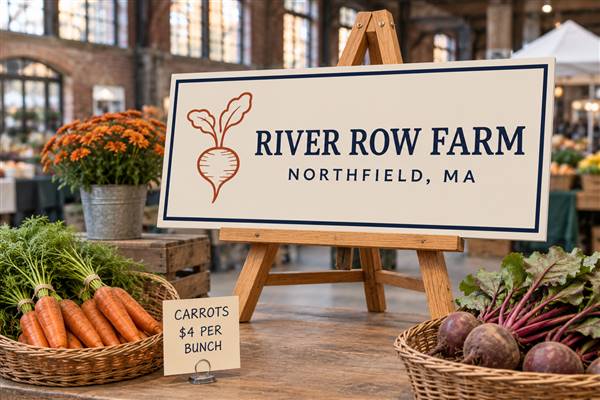
A rigid name panel for a dry indoor market
DecentCustom’s custom foam board signs list 5 mm foam, a smooth matte surface and full-color UV single-sided printing. The page lists horizontal and vertical orientations and size options from 4 to 100 inches.
Confirm the exact dimensions, shape, artwork, quantity and display support before ordering. This indoor concept does not establish rain resistance, wind performance or suitability for an outdoor market. The product listing does not make an easel part of the printed board.
Compare custom marketing materials if your venue or placement needs another format, or explore custom products from DecentCustom once you have defined the job.
Before approving artwork, read the farm name from the intended viewing position and review a product card beside the real selling unit. The useful result is a shopper who can identify the stall and understand an offer. Whether a new display achieves that—and whether it changes sales—needs observation at your own market.