
You ask for a soft pretzel and find three names on the menu: Philly, Bavarian, and Swabian. They are all pretzels, but the name you recognize may not describe the bite you wanted. A familiar knot shape does not settle the question either.
Philly, Bavarian, and Swabian describe different soft-pretzel traditions, with variation between bakeries. Use the style name as a starting point, then ask about the actual item’s crust, center, shape, and toppings. Bavarian does not mean the opposite of soft: a pretzel can have a crisp exterior and a soft interior.
This is a buying guide for choosing from a shop’s current menu. It is not a recipe, an authenticity test, or a ranking of which region makes the best pretzel.
A practical map of the names
These descriptions help you ask a better question. They are not specifications that every bakery must follow.
| Style name | Common description | Useful question at the counter |
|---|---|---|
| Philly | A compact, flattened figure-eight is a familiar Philadelphia form. | “Is this your classic figure-eight? How do you describe its skin and center?” |
| Bavarian | Often a rounder looped form. A crisp crust and soft center can occur together. | “What is the outside like on the one you are serving today?” |
| Swabian | Commonly described with a thick, scored belly and thinner arms. | “Does this one have thin arms and a thicker middle, or is it your own variation?” |
Visit Philadelphia’s pretzel guide identifies the figure-eight among the city’s familiar forms while also covering other shapes and styles. A pretzel bought in Philadelphia is not automatically the same item as a menu’s “Philly-style” pretzel.
For the German regional distinction, IREKS’ baking compendium describes the Bavarian form as relatively round, with a more even strand, and the Swabian form as having a scored, thicker belly and thinner arms. It also recognizes regional differences. The useful takeaway for a buyer is that “German pretzel” is a broad description.
A style name cannot answer every ingredient question
Recipes and adaptations vary. In a FRITSCH interview with Milwaukee Pretzel Company’s cofounder, the baker explains that the company adapted its shape for the American market. That is a concrete reason to avoid treating one outline as a complete authenticity test.
Milwaukee Pretzel Company’s own description pairs a crisp exterior with a pillowy inside and lists ingredients including butter, rye flour, and malt. Those are descriptions of its products. They should not become rules that every Bavarian-style pretzel must share.
If a particular ingredient, coating, or filling matters to your purchase, ask the bakery about the exact named item. Do not infer its recipe from the word “Bavarian,” from a glossy photograph, or from what another shop puts in a similarly named pretzel. A short style description is not a complete ingredient statement.
Describe the bite you want
“A good pretzel” can mean different things to different people. You will give staff more to work with by naming a preference:
- Crust: “I like a distinct crisp bite outside,” or “I prefer a softer skin.”
- Center: “I want a soft, pillowy middle,” or “I enjoy a firmer chew.”
- Shape: “I like the thin arms and thick belly,” or “I’m looking for the compact figure-eight.”
- Finish: “Which toppings or coatings come on this exact item, and which are optional?”
In a March 2026 discussion of a new pretzel shop, commenters used “Swabian” while another questioned what that meant. The discussion also contained different opinions about value. It illustrates why explaining the actual product helps; anonymous preferences do not establish a winning style or a standard price.
You do not need to know the right regional term before ordering. “I liked the crisp outside and softer middle on the one I had last time” can be a better starting point than guessing a name. Staff may then identify a current option—or explain that nothing on today’s menu matches.
Two finished choices at a fictional counter
Lena wants contrasting textures
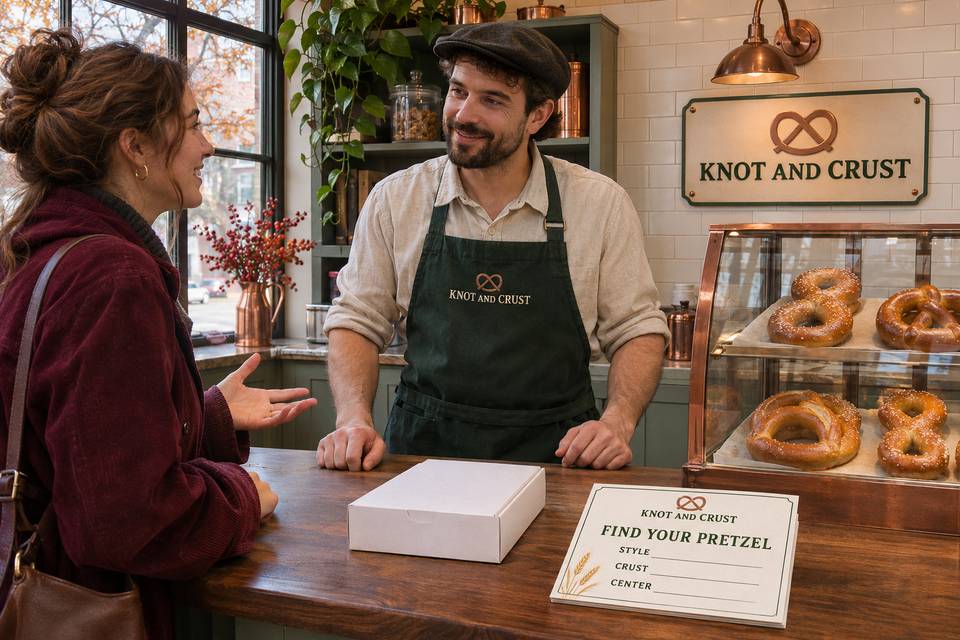
Lena remembers enjoying a pretzel with a crisp outside and soft middle, but does not remember its name. She asks the fictional KNOT AND CRUST owner to compare the current Classic Figure-Eight and Round Bavarian Twist.
For this example, the owner describes the Round Bavarian Twist as having the contrast Lena wants, while the Classic Figure-Eight has a softer skin. Lena chooses one Round Bavarian Twist with its standard salted finish, after checking what that finish includes. She has made a choice based on the shop’s description, rather than assuming every Bavarian pretzel tastes identical.
Noah wants the thinner arms
Noah is specifically looking for a pretzel with very thin arms and a thicker belly. The owner says the shop’s Swabian-style version is unavailable, and today’s round twist has a more even thickness. Noah decides to wait rather than buy the substitute. He asks how to check the future menu, without assuming the item will be available on a particular date.
The shop, customers, menu names, availability, and descriptions in these examples are invented. They demonstrate a completed decision, not a taste test or a claim about an actual bakery.
Lena’s completed taste note
- Shop: KNOT AND CRUST, fictional example.
- Exact menu item: Round Bavarian Twist.
- What I was looking for: crisp exterior, soft middle.
- Chosen finish: standard salted finish, as explained by staff.
- Next visit: ask whether the same item and finish are currently offered.
A note on your phone or the item name on a receipt is enough. If you want to record what you personally thought after eating it, add that observation separately. The regional label and the shop’s description do not replace your own preference.
For pretzel shops: pair the name with a useful description
Customers should be able to understand the difference without a history lesson. Put the exact menu name beside a short description of your own product, its usual finish, and a helpful question staff can answer. Keep unavailable items clearly separated from the current selection.
The Philly Pretzel Factory menu, for example, distinguishes pretzels, twists, and mini formats and directs customers to local stores for availability. That is a useful reminder to explain the particular item, not just the broad category.
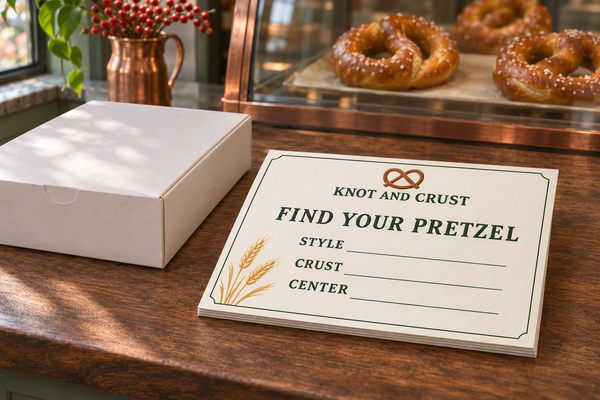
A current menu and a clear staff explanation may be all you need. For an optional takeaway guide, custom postcards for pretzel shops can carry a few buying questions and space for a customer to remember an exact item.
A small guide, kept current
DecentCustom offers full-color postcards with size and stock options, including a 6 × 4-inch landscape format. Confirm the chosen stock, finish, trim, bleed, and artwork requirements before ordering.
The card helps explain or remember a menu choice. It does not verify texture, ingredients, or availability. If customers will write on it, confirm a suitable finish rather than assuming every stock behaves the same way.
Compare custom marketing materials, or browse custom products from DecentCustom for another appropriate format.
Soft pretzel style questions, answered
Is a Bavarian pretzel still a soft pretzel?
Yes. “Soft” does not mean every part must have the same texture. A crisp crust and soft interior can occur together. Ask how the particular bakery describes the item it is serving, rather than treating Bavarian and soft as opposite categories.
Are Bavarian and Swabian pretzels the same?
They are different regional traditions. A common distinction is a relatively even, rounder Bavarian form versus a Swabian form with a thicker belly and thinner arms. Bakeries also make their own variations, so confirm the actual item and finish on the menu.
Can I identify the recipe from the shape or the shop’s city?
No. Shape and location provide context, not a complete recipe or ingredient statement. A bakery may adapt a regional form or offer several styles in the same shop. Ask about the exact named product when an ingredient, coating, or filling matters to your choice.