
You have agreed to bring bagels to an office breakfast. Two catering menus look similar, yet one lists a dozen bagels, another counts halves, and neither makes it obvious whether the spreads and knives are coming with the box. Comparing the headline price will not settle the order.
For bagel catering, compare what arrives: whole bagels, spread quantities, preparation, and serving extras. Confirm the actual count behind “dozen,” whether the bagels are sliced or already spread, and the size and number of cream-cheese containers. Then check plates, napkins, spreaders, coffee accessories, and any separate charges.
This guide helps you turn a vague breakfast package into a usable order. It does not set one portion rule for every crowd. Appetites, bagel sizes, other food, and the selected shop’s packages can change the right choice.
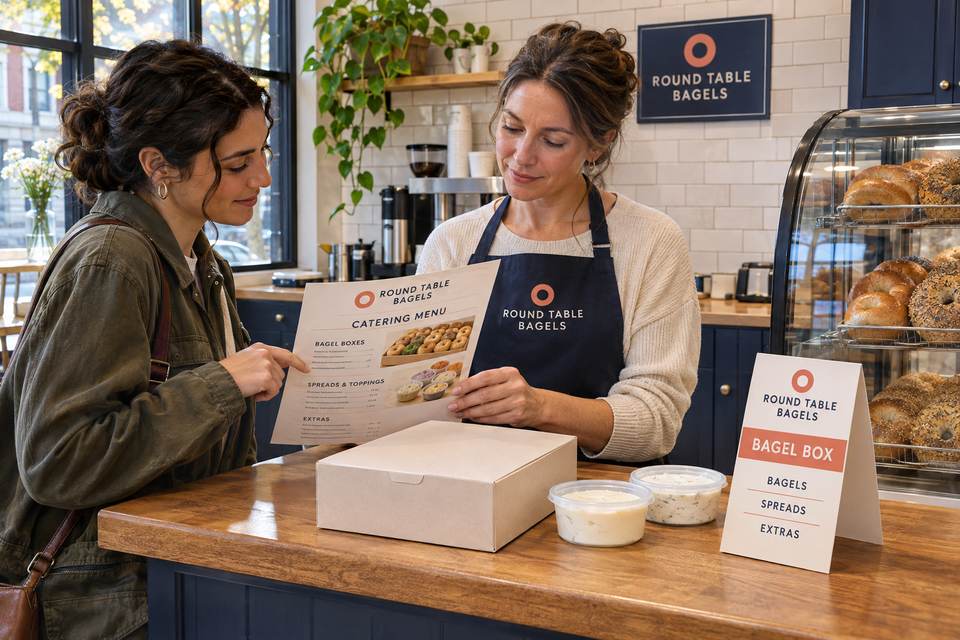
Read the box contents before the serving claim
“Serves 12” is a planning description. “12 whole bagels, sliced into 24 halves” tells you the physical quantity. Keep both in your notes, but do not treat them as interchangeable.
| Menu wording | What to establish | Why it matters |
|---|---|---|
| Dozen bagels | 12, a baker’s dozen of 13, or another named package? | Count whole bagels before comparing boxes. |
| 18 halves | Does that represent 9 whole bagels? | Cutting creates pieces, not extra bagels. |
| Cream cheese included | How many containers, which flavors, and what amount in each? | A “tub” alone is not a quantity. |
| Ready to serve | Sliced, pre-spread, wrapped, or build-your-own? | The host’s remaining setup can be very different. |
Gotham Bagels’ catering menu illustrates the distinction: its NY Dozen contains 13 bagels, while its bagel-and-cream-cheese platter describes 9 bagels cut into 18 halves. These are that shop’s named formats, not a definition to apply to every menu.
Also check the location and package name. A brand can offer different formats at different shops. A photo of a large platter does not establish the count or extras in the item you selected.
How much cream cheese comes with a dozen?
There is no single amount hidden in the word “dozen.” Published shop advice differs. Rosenfeld’s event-ordering guide suggests one pound per dozen bagels. Gotham’s menu suggests three 8-ounce containers with its 13-bagel dozen. Both are vendor-specific starting points.
The practical next step is to ask your selected shop what it recommends for its bagels and your breakfast, then compare that recommendation with what the package actually includes. Tell the shop whether bagels are the main food or one option alongside other breakfast items. Mention known preferences for a light or generous spread without assuming everyone eats the same amount.
An August 2022 work-breakfast question describes exactly this uncertainty: the organizer wanted enough cream cheese without buying so much that it would be wasted. The comments contain different preferences. They help explain the question; they do not establish a standard serving size.
Compare like units
Record a container’s listed amount and unit. In U.S. weight units, 16 ounces equals one pound. Do not assume an 8-fluid-ounce container holds 8 ounces by weight, or convert cups into weight without product-specific information. Ask for clarification when a menu only says “small tub.”
A simple calculation when the shop gives a weight-based recommendation:
Whole bagels × recommended ounces per whole bagel = total ounces.
Round up total ounces ÷ ounces per available container to a whole container.
Use the amount for each selected product. This calculates containers under your stated assumption; it does not prove what guests will eat.
A complete example: 24 bagels, not 48
Fictional organizer Morgan has already agreed with the team and shop on 24 whole bagels for a breakfast that also has fruit. This is an example order, not a recommendation for 24 people.
The fictional shop recommends 2 ounces of spread per whole bagel for this order and sells it in containers labeled 8 ounces by weight. Morgan calculates 24 × 2 = 48 ounces, then 48 ÷ 8 = 6 containers. The shop confirms the requested mix is available.
Morgan’s completed package note
- Bagels: 24 whole, pre-sliced into 48 halves; not pre-spread.
- Mix: 12 plain and 12 everything, as confirmed with the shop.
- Spreads: six 8-ounce containers: four plain and two scallion; 48 ounces total by listed weight.
- Serving items: the shop includes spreading knives and napkins; the office supplies plates.
- Drinks: office coffee, so no coffee box or coffee accessories are ordered.
- Price check: the written quote identifies food, slicing, delivery, and tax; Morgan checks the final amount before ordering.
The package details and quantities above are invented to show a finished comparison. They are not a promise that a particular bakery includes these services.
When the plan changes, recalculate the actual order
The team later reduces its agreed order to 16 whole bagels. Using the same confirmed example recommendation, Morgan needs 16 × 2 = 32 ounces, or four 8-ounce containers. Morgan changes the request to 8 plain and 8 everything bagels, two plain and two scallion containers, and checks that the shop accepts the revised quantity and mix.
If the package minimum still requires 24 bagels, Morgan compares buying the smaller quantity separately with keeping that package. Morgan does not assume a smaller headcount automatically changes a fixed box.
Check the work and extras that remain
Slicing is worth asking about directly. In a September 2026 party-planning discussion, the original poster’s update says pre-cutting and an ordering minimum affected their choice of shop. That is one person’s reported experience, not independently verified current policy for those businesses.
Bennington Bagel Company’s catering form separately lists slicing with an extra charge and selections for spreading knives, napkins, and coffee accessories. By contrast, Knickerbocker Bagel’s catering page states that its packages include utensils. “Catering” alone does not resolve the difference.
For your own order, settle these points:
- Are bagels whole, sliced, or already assembled?
- Are spreads separate, and is each container identified by flavor?
- Who supplies spreading knives, plates, napkins, and any serving utensils?
- If coffee is included, are cups, stirrers, and the selected accessories included too?
- Which delivery, slicing, and other charges remain outside the package price?
For price comparisons, use food + chosen extras + applicable delivery and tax, with the same quantities and services on both sides. Keep an unquoted fee marked “ask shop,” rather than entering zero. If you collect the order yourself or use office supplies, include that choice in the comparison.
For bagel shops: explain the package where customers choose
A short current menu or email can answer the key question: “What is in this box?” Lead with the whole-bagel count, then describe the cuts, spread quantities, and included extras. Keep optional items in a separate line. Staff can use the same wording at the counter.
If a freestanding counter reminder fits your space, custom table tents for bagel shops provide a printed format for those details.
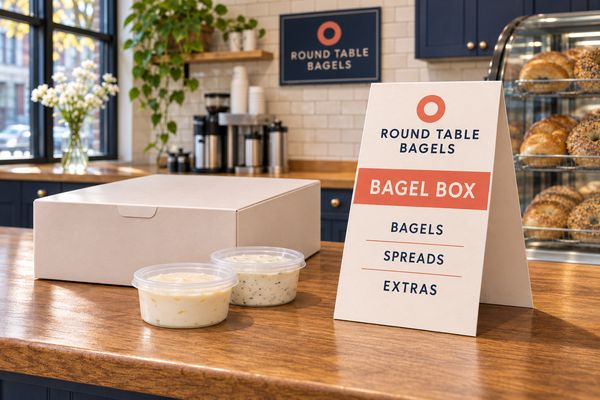
Keep the printed message specific
DecentCustom lists this table tent in a 5 × 7-inch format with 14pt cardstock and full-color printing. Confirm the fold template, finish, artwork, and trim requirements before ordering.
The tent can explain a current package. It does not confirm an order or automatically update a changing menu. Plain text on your website may be sufficient; print only the information you can keep accurate.
Compare custom table tent printing, or browse custom products from DecentCustom for another suitable format.
Bagel catering questions, answered
Does a dozen bagels always mean 12 servings?
Check the actual count and the shop’s serving guidance. A package may contain 12 whole bagels or a baker’s dozen of 13. Slicing 12 whole bagels into 24 halves does not turn them into 24 whole-bagel portions. The right order also depends on the other food and the group’s needs.
Is one pound of cream cheese enough for a dozen bagels?
Some shops recommend that amount; others suggest more for their bagels. Ask the shop you are buying from, specify whether bagels are the main food, and compare its advice with the package’s actual included weight. Personal preferences also vary.
Are slicing and utensils included in bagel catering?
Sometimes, but the word “catering” does not guarantee either. Check the exact package for slicing, spreading knives, napkins, plates, and coffee accessories. If a service is optional or unclear, get the inclusion and any charge confirmed before ordering.