
Farm stores & farm shops · Product origin and grower stories
“Did you grow these?” is a reasonable question in a farm shop. A visitor may be looking at your own carrots, a neighboring orchard’s apples and jam made by another business on the next shelf. The farm name above the door does not answer the question for each item.
Identify the product, who grew or made it, and the place you can verify. Make clear which item the statement describes. Keep the grower’s identity separate from the shop selling it, and update the information when the source changes. A clear handwritten sign can do this as well as a printed one.
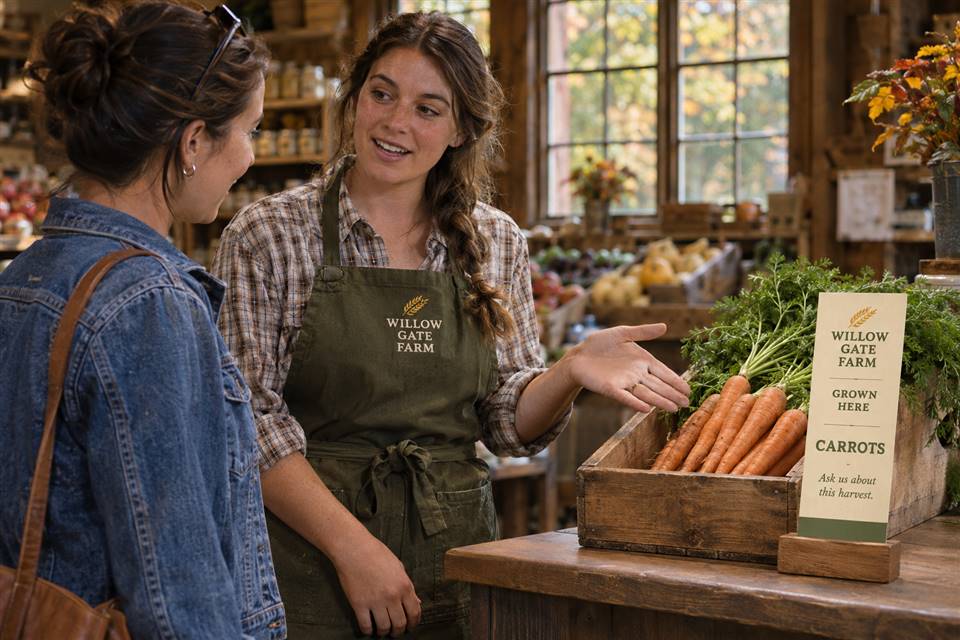
A customer can welcome more choice and still want a clear source
In a farm-produce discussion, the original poster says they had assumed farmers grew the crops they sold, then learned that their local farm obtained some products from another supplier. They did not object to the wider selection; they wanted to understand it. That is one unverified account from 2024, not a finding about how American farm shops generally operate.
A mixed range is not an unusual concept in farm-shop literature. Utah State University Extension’s farm-shop article describes shops offering fresh or processed products from one farm or multiple farms. Its 2020 context should not be mistaken for current market statistics, but the distinction is useful: the shop and the producer need not be the same business.
For an owner, the communication task is to make that relationship easy to see. A brief explanation at the entrance can describe the range, while the information beside a product answers who supplied that particular item. Do not make the visitor infer its origin from rustic packaging, a farm photograph or the shop’s logo.
Three completed examples for a mixed farm-shop range
These examples use invented businesses and products. The Massachusetts locations illustrate useful specificity, not actual suppliers, verified inventory or a legal labeling template.
Carrots grown by the shop’s farm
CARROTS — GROWN BY WILLOW GATE FARM
Hadley, Massachusetts
These carrots were grown on our farm.
This statement belongs with those carrots. It does not establish the origin of every vegetable elsewhere in the shop. If the farm uses several growing sites and the location matters to the answer, say which site the current product came from.
Apples from another grower
APPLES — GROWN BY ORCHARD LANE FARM
Deerfield, Massachusetts
Offered here by WILLOW GATE FARM.
The grower is named first; the seller’s role is explicit. A delivery company’s address alone does not identify the orchard. If your records identify only the supplier, describe that verified relationship and ask for the grower’s details before naming a farm of origin.
Jam made by a separate business
STRAWBERRY JAM — MADE BY MILL KITCHEN
Greenfield, Massachusetts
Ask us for the maker’s product information.
This identifies the maker and place of preparation. It does not say where the strawberries were grown. “Made nearby” and “fruit grown on our farm” answer different questions. Keep the product’s own label and required information available; a story card is supplementary communication, not a complete labeling system.
There are useful retail examples of putting origin at the product display. Willy Street Co-op’s shelf-tag explanation says its produce signs include a country, state or local farm of origin. Its own “Local” icon has a store-specific definition. The transferable idea is to explain your wording and identify the item’s source; that icon is not a universal rule for farm shops.
When a new delivery changes the answer
Suppose the morning’s carrot display came from WILLOW GATE FARM, and a later delivery comes from another grower. Reusing the old “Grown Here” card would leave the previous answer in place after the underlying fact changed.
Start with the current product and its source record. Confirm the grower or supplier details that your receiving information supports, then check the wording beside the display. Replace the old origin statement with the verified current one. If more than one source is represented, the display and its explanation need to make that scope understandable; a card beside one section should not appear to describe all the stock.
Give the person updating the display one simple handoff: “The source changed; this is the current product information, and this is the sign that needs replacing.” Check the corresponding online availability post or product description too if it repeats the old origin. A printed card cannot make an outdated statement accurate.
If the source is not yet confirmed, a useful response is: “I can confirm who supplied this item. I need to check who grew it before I give you a farm name.” Ask the responsible employee to follow up. Do not turn a guess into a confident “grown here” answer.
Separate the stable farm story from changing item facts
A grower profile can introduce the people and place behind a product. Current source, price, selling unit and availability may need a different update cycle. Keeping them distinct makes the story easier to maintain without allowing it to stand in for today’s facts.
University of Maine Extension’s communication guide recommends clear, concise signage and a consistent farm snapshot across printed material and the website. Use that consistency for names and identity, while keeping each claim specific to the product it describes.
The UVM Extension display checklist also separates permanent product labels from changing prices and suggests a staff reference for frequently asked questions. Applied to a farm shop, that means an employee should be able to find the same verified source explanation that the customer sees. It does not require printing a new promotional card every time a price changes.
Questions to answer without a vague “farm fresh” reply
Does a farm shop grow everything it sells?
Ask the individual shop. Some ranges include products from the farm itself and from other growers or makers. A useful answer names who produced the item you are considering and distinguishes that producer from the retailer. The shop’s name alone does not tell you the answer.
If jam is made here, was the fruit grown here too?
Not necessarily. The place of preparation and the source of the ingredients are separate facts. Ask the maker or shop for the information it can verify about that product. A locally made story should not be treated as a statement about every ingredient’s growing location.
What if the sign does not name a grower?
Ask who supplied the current item and whether the grower and growing location can be confirmed. A seller may need to check its records or contact the supplier before answering. If origin is important to your purchase, decide after you have the information you need rather than relying on the display’s appearance.
Use a printed grower card for information that will stay useful
An ordinary paper sign, existing price card or whiteboard may be enough. A printed rack card is an option for a concise, repeat-use grower profile or a take-home farm introduction. Give it a clear relationship to the relevant product and keep changing facts easy to replace.
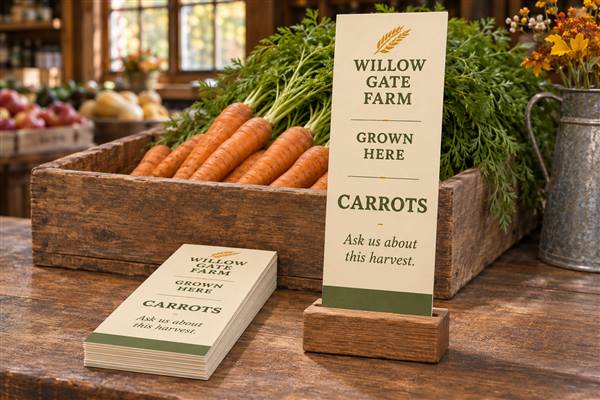
A slim paper format for a grower introduction
DecentCustom’s custom rack cards list a 3.74 × 8.27 inch size and full-color printing. The default is 14pt stock with a glossy finish; the page lists other stock and finish combinations.
Confirm the selected combination, print layout and quantity on the proof. Plan a separate holder or other suitable display support. A paper profile card is not automatically a weatherproof outdoor sign, and printing a farm name does not verify product origin.
Compare other custom marketing materials for a different placement or amount of information. Explore the wider custom products from DecentCustom after choosing the communication task.
Before printing, show the proposed display to someone unfamiliar with it. Ask who grew the carrots, who sells them and whether the statement appears to cover other items nearby. If those answers are ambiguous, revise the words or placement. This is a suggested reader check, not a completed test of customer understanding or sales.