
You are ordering cupcakes for a shared celebration. The menu has enough tempting names to fill three boxes, but you need one order that makes sense. The useful question is not simply which flavor wins an online poll. It is which combinations your guests will recognize, how the bakery lets you mix them, and what each choice contributes to the assortment.
Decide what you are choosing before asking for votes
In an October 2026 engagement-party discussion, a host asked people to choose among cupcake flavors. A respondent initially understood the question as choosing one flavor for the whole order. The host later clarified that the order would contain four dozen and that the real question concerned the remaining mix.
That difference changes the decision. “Which one would you pick?” is useful for learning an individual preference, but it does not tell you how to divide a mixed order. Before comparing flavors, write down whether you want a single-flavor box, a ready-made assortment, or a custom mix. Give the bakery the event context and ask it to help establish the appropriate total separately.
If you already know your guests want one particular flavor, a single-flavor order can be a good outcome. You do not need to add variety just to make the menu sound more impressive.
Give each flavor a reason to be in the box
The party cupcake guide from Toronto’s Pastel Bakes starts with the occasion and discusses combining familiar choices with contrasting ones. That is a useful way to organize a shortlist; it is not evidence that one mix will please every group.
Ask what a second or third flavor adds. A chocolate option may serve people who specifically asked for chocolate. A lemon combination may offer the fruit direction another guest enjoys. An unfilled vanilla cupcake may suit someone who wants a straightforward cake-and-frosting combination. These are preference examples, not rankings or ingredient-suitability claims.
Two different names can still produce a very similar eating experience. Conversely, two cupcakes with pale frosting may have different cakes and centers. Compare the actual descriptions rather than treating the decoration as the flavor key.
Read the whole combination: cake, filling, frosting
A name such as “vanilla” may describe only part of a cupcake. Tampa Bay Cake Company’s flavor menu, for example, distinguishes fillings from buttercreams and explicitly excludes minis from its statement about filled cupcakes. Its particular products do not establish how another bakery makes its range.
For every shortlisted option, ask: What is the cake? Is there a filling, and what is it? What frosting finishes it? If the menu does not answer, ask the team before deciding. Also check whether the combination you want is offered in your chosen cupcake size.
You might discover that the chocolate option you pictured as plain actually has a filled center. The useful next step is to ask for an available alternative that matches your preference, rather than assuming the shop can remove or change any component.
Check the mixing rules before dividing the total
“A dozen” does not tell you how many flavors can go inside it. Two US bakery examples show why the question matters:
- Patty’s Cakes describes its mini cupcakes as ordered by the dozen, with four flavors grouped in threes.
- Bean Counter Bakery’s wedding mini cupcakes list a minimum of one dozen per flavor.
Those are different products and businesses, with their own conditions. Neither rule applies automatically to your shop. Confirm the current minimum per flavor, allowed increments, available combinations, and whether a preset assortment follows different rules. Check again if you switch from standard cupcakes to minis.
Only then allocate the quantities. If a desired mix does not fit, choose between fewer flavors, an available preset box, or a different total discussed with the bakery. Do not assume that adding names to an email changes the shop’s production or box options.
A worked assortment decision
Fictional example: Avery has already discussed the event with a bakery and settled on an order of 24 standard cupcakes. This number is an order constraint for the example, not a recommendation for 24 guests or a prediction of consumption.
The fictional bakery offers mixing in groups of six, with a six-cupcake minimum per flavor. Avery’s group has asked for vanilla and chocolate, and several people also enjoy lemon. After confirming the available combinations, Avery chooses:
| Confirmed combination | Quantity | Role in this order |
|---|---|---|
| Vanilla cake, no filling, vanilla frosting | 12 | The specifically requested familiar choice |
| Chocolate cake, no filling, chocolate frosting | 6 | A distinct chocolate option |
| Lemon cake, lemon filling, vanilla frosting | 6 | The requested citrus alternative |
The check is simple: 12 + 6 + 6 = 24, and every quantity meets that fictional bakery’s six-at-a-time rule. Avery confirms the three descriptions and quantities with the shop. The final mix follows known preferences and actual options; it does not rely on an internet popularity contest.
Now change one condition. If the chosen bakery instead requires 12 per flavor, the same three-way split would not work. Keeping the agreed total of 24, Avery chooses 12 vanilla and 12 chocolate after checking with the group. The lemon option drops out rather than silently increasing the order. Another host might choose a different pair; the point is to resolve the trade-off deliberately.
Make the final assortment easy to identify
A January 2024 discussion about six dessert flavors contains directly conflicting preferences: some commenters wanted a simpler option, while others liked the more unusual combinations. One person reported success with a larger assortment. These accounts show the limits of a universal “best flavor” answer, not a measured rule about guest behavior.
Give people clear flavor information for the order you actually have. For Avery’s fictional lemon option, a useful line would be:
Lemon cake · lemon filling · vanilla frosting
Use that description only when it matches the bakery’s confirmed product. It is a flavor description, not a complete ingredient statement or a suitability assurance. If a combination changes, update the list rather than leaving the old center or frosting printed on it.
A bakery can provide a current menu, a host can use a handwritten list, or staff can explain the choices. The essential job is connecting each name to the correct cupcake. Decorative colors can complement that information, but should not carry the whole explanation.
For cupcake shops: print the information you can keep accurate
For a recurring counter menu, a branded table tent can present a short flavor overview. Choose a few readable lines and keep the current details available from the team. If the assortment changes frequently, a simple current list may be more practical than reusing an outdated printed display.
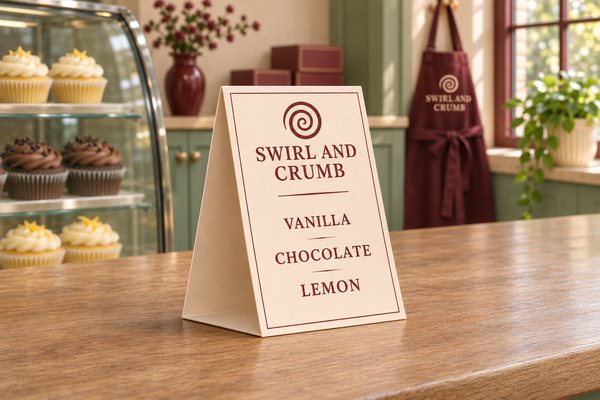
A freestanding cupcake flavor display
DecentCustom’s custom table tents for cupcake shops, SKU decentcustom-mm-000008, list a 5 × 7-inch size, full-color printing, and standard 14pt cardstock. The page lists matte and glossy finishes, with glossy as the default. Confirm the current artwork template, fold layout, and chosen finish before ordering.
Explore custom table tent printing, or browse custom products from DecentCustom for coordinated shop branding. Keep the display separate from the cupcakes; it is a communication piece, not food packaging.
Cupcake assortment questions
How many cupcake flavors should I choose for a party?
Choose enough to reflect the preferences you actually know, within the bakery’s available mixing rules and your agreed total. One known favorite can be enough. Add another option when it offers a useful difference; there is no required three-flavor formula.
Can I split a dozen among any flavors on the menu?
Ask the bakery. Some products allow several flavors in one dozen, while others have a per-flavor minimum. Confirm quantities and increments before treating the menu as a build-your-own box.
Are mini cupcakes available in the same combinations as standard ones?
Do not assume so. A bakery may offer different fillings, flavors, or mixing rules for minis. Ask for the current mini range and confirm the complete combination before transferring a standard-cupcake selection to that size.
A good assortment is a set of clear choices that fits the order. Start with real preferences, work within the bakery’s actual options, and finish with quantities and descriptions everyone can understand.