
A cookie can look exactly right in the display case and still have the wrong bite for you. The chocolate looks generous, the edges look golden, and the name sounds promising. What you actually wanted, though, was a crisp edge with a chewy center—or a clean crunch all the way through.
When choosing crispy vs chewy cookies, describe the edge and the center separately. Ask about a specific cookie on the current menu: “Is this crisp throughout, or does it have a chewy center?” If you dislike a cake-like crumb, say that too. “Soft” alone leaves room for several very different textures.
This guide helps shoppers make that choice and cookie-shop owners describe what they sell. It is a buying conversation, rather than a recipe guide: a photograph cannot establish a cookie’s texture, ingredients, freshness, or doneness.
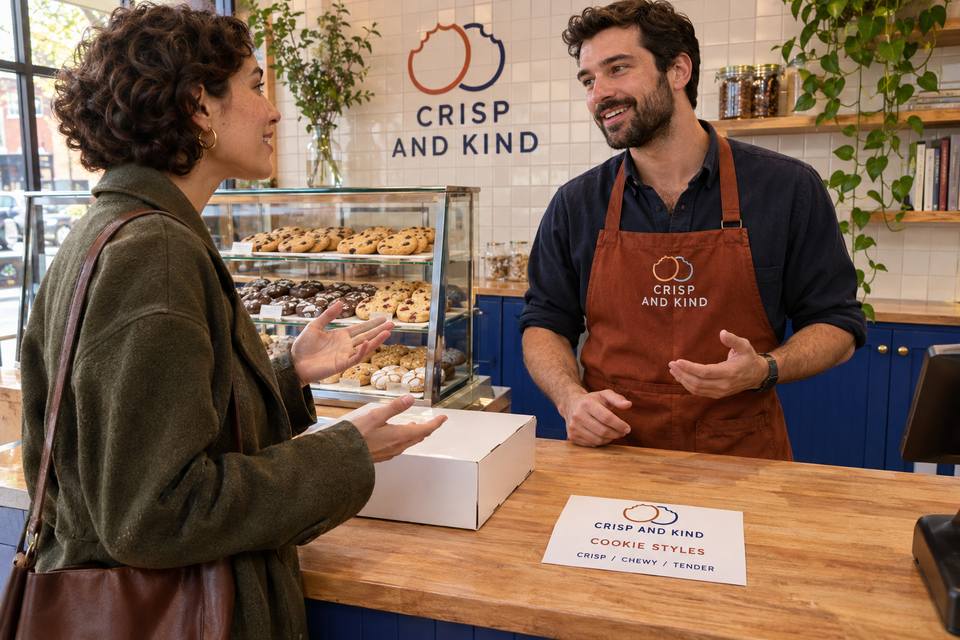
Crispy, chewy, soft, and cakey: what are you asking for?
Think about the experience you enjoy, then translate it into a short description. You do not need technical vocabulary to ask for “a cookie that crunches through the middle” or “a center that has some chew without a fluffy crumb.”
| What you want | A useful description | What to clarify |
|---|---|---|
| Crisp throughout | A clear crunch at the edge and through the center | “Is the middle crisp too?” |
| Chewy center | A center with resistance as you bite and chew | “Is it chewy, or more tender and cake-like?” |
| Soft and tender | A gentler bite without much resistance | “Is the crumb dense, or light and cakey?” |
| A contrasting bite | Crisp edges with a softer or chewy middle | “How would you describe the edge and the center separately?” |
These descriptions overlap. As Preppy Kitchen’s cookie texture guide explains, chewiness and softness describe different qualities; a cookie can also combine crisp edges with a softer center. Fat & Weird’s texture guide similarly separates chewy, soft, and cakey profiles. Use the terms as a starting point, then ask the shop how they apply to its own cookies.
There is no single winning cookie texture
Two familiar bakery descriptions show why a one-word label is incomplete. The specific Tate’s chocolate chip cookie is presented as thin and crispy. In contrast, Levain’s account of its original cookie describes a crisp exterior and a gooey middle. Those are different intended eating experiences, not a universal ranking of quality.
Neither example tells you what an unrelated bakery’s cookie will be like. Even “crunchy” and “chewy” can mean different things to different people, a point acknowledged in King Arthur Baking’s cookie comparison. A helpful shop description connects the label to one named product, rather than assuming everyone shares the same definition.
Can you tell cookie texture just by looking?
Not reliably enough to make the promise a shopper needs. In a December 2025 baking-forum question, a buyer described repeatedly choosing appealing-looking cookies that did not deliver the chewiness they wanted. Their practical constraint was familiar: in a shop, you can look, but you cannot squeeze the cookies in the display.
That individual account is a useful buying problem, not a survey of shoppers. It also does not validate the visual shortcuts offered in replies. Thickness, color, surface shine, and visible chocolate do not establish the exact bite of an unfamiliar cookie. Ask for a description instead of treating an attractive photograph as a texture test.
Try this short conversation:
Customer: “I like a crisp edge and a chewy center. I don’t enjoy a fluffy, cake-like middle. Which of today’s cookies is closest?”
Staff: “Our current chocolate chip option has a crisp edge and a tender, cake-like center. The thin chocolate cookie is crisp throughout. We don’t have a chewy-center option today.”
Customer: “Thanks—that helps. I’ll choose the thin chocolate one today because I also enjoy an all-over crunch.”
The useful part is the specific description and the customer’s choice. Staff should describe the actual current product and acknowledge uncertainty when they cannot answer. If tasting samples happen to be offered, ask about the option you are considering; do not assume a sample is available or required.
Two shoppers, two reasonable decisions
Jordan wants crunch all the way through
Jordan is drawn to a large chocolate chip cookie but asks whether its center crunches. The owner explains that this particular cookie has a soft center. Another named option on the current menu, Thin Chocolate Crisp, is crisp throughout.
Jordan buys Thin Chocolate Crisp and records its exact menu name. The larger cookie was appealing, but it did not match the texture Jordan wanted. The decision came from the shop’s description, rather than from judging the large cookie by appearance.
Mei wants chewiness without a cakey crumb
Mei asks for a chewy center and explains that a light, cake-like crumb is not what she has in mind. The shop has two options today: one crisp throughout and one with a soft, cakey center. Neither matches that preference.
Mei decides to wait rather than buy an unsuitable substitute. The owner does not promise that a different cookie will be available on a particular day. They suggest checking the current menu before another visit. A clear answer still helped, even though it did not produce an immediate sale.
Both examples are fictional. Cookie names and availability are invented to show the decision; they are not products or policies of a real bakery.
Save the cookie name, not just “the chewy one”
Once you find a cookie you enjoy, keep a small note. A phone note, the menu name on a receipt, or a handwritten reminder is enough. Record what you actually experienced after trying it, rather than copying a photo’s appearance.
Example preference note
Shop and exact cookie: Fictional CRISP AND KIND — Thin Chocolate Crisp
What I wanted: A clear crunch throughout
What I experienced: Crisp edge and crisp center
What I liked: The center matched the description
Next time: Ask for this named option if it is on the current menu
For a gift, replace “I want” with “the recipient enjoys,” and use a preference you actually know. If you do not know their preferred texture, ask them or offer a choice between clearly described options. An internet debate about the best cookie cannot answer that personal question.
For shop owners: a small style card can make the description visible
Start with accurate menu wording. A short description such as “crisp edge; tender, cake-like center” says more than “our best cookie.” Have staff use the same terms, and make clear which named option each description belongs to. Change the description when the product changes.
A plain menu or handwritten card may do the job. If you want a separate branded handout, custom postcards for cookie shops are one optional format. DecentCustom’s current postcard page includes a 6 × 4-inch landscape option and multiple paper and finish choices; the illustrated flat card below is a concept for that format.
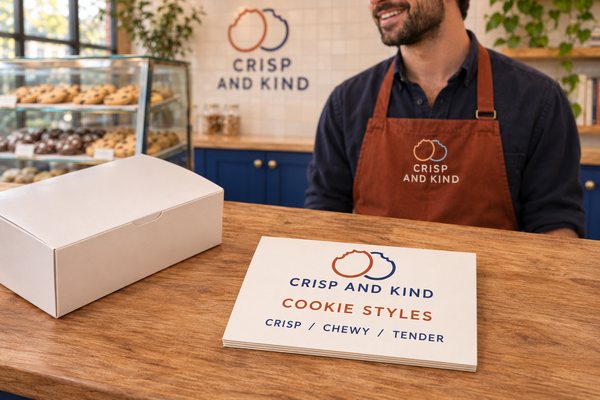
Keep the card specific to your menu
List the exact cookie name, edge description, and center description. A customer can take the card away to remember an option; it does not replace the current menu or confirm future availability.
Confirm the selected size, stock, finish, trim, bleed, and artwork requirements before ordering. Keep the card separate from exposed food; this is not a food-contact or freshness claim.
Compare related custom marketing materials, or browse custom products from DecentCustom if another format suits your counter better.
Cookie-shop questions, answered
Are chewy cookies the same as soft cookies?
Not necessarily. Chewy describes resistance during the bite; soft describes a gentler bite. A soft cookie may have a tender or cake-like crumb that feels quite different from the chewy center you wanted. Tell the shop which quality matters to you and ask about a named cookie.
Does a thick cookie always have a chewy center?
No. Thickness alone does not establish texture. Ask how that cookie’s center is described, and explain whether you prefer chewy, tender, or cakey. A photograph or the amount of visible chocolate is not a substitute for that answer.
Can a cookie be crispy and soft at the same time?
Yes: the edge and center can have different textures. Ask whether “crispy” describes the edge or the whole cookie, then ask about the middle separately. That distinction helps you choose between an all-over crunch and a contrasting bite.