
Your recipe says pearl barley. The pantry store has a bag marked hulled barley, another marked hull-less, and a bin that simply says barley. Before choosing the closest-looking grain, find out what those words describe.
Pearled barley has been polished to remove some or all of the bran along with the outer hull. In retail food descriptions, hulled or dehulled barley generally means the inedible hull has been removed while the bran is retained. Hull-less describes a variety whose hull separates readily. Match the product’s actual processing and form to your recipe; the words are not a promise of identical preparation.
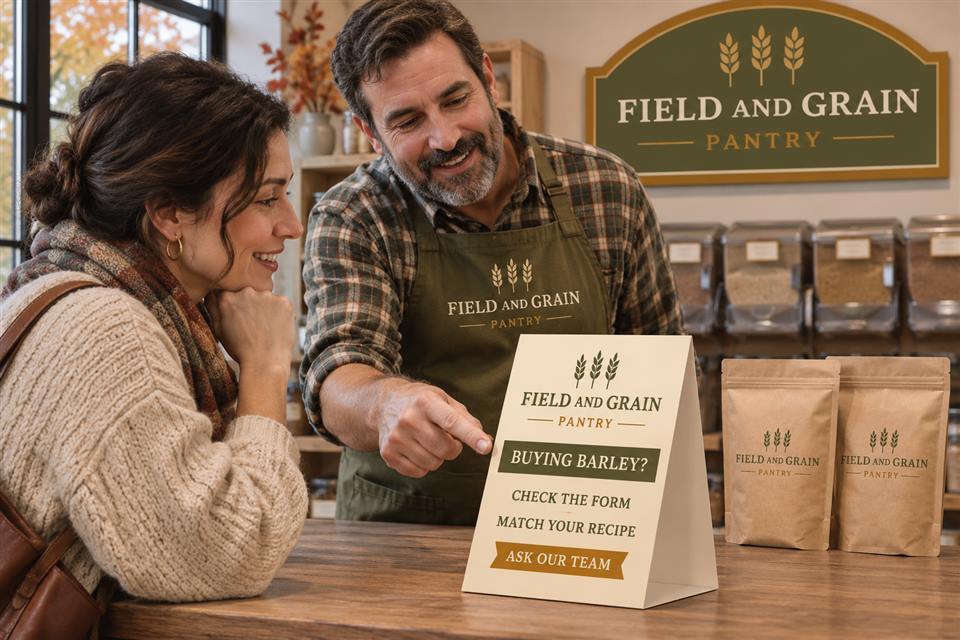
Why the names are easy to mix up
In a September 2020 barley discussion, a shopper found apparently contradictory descriptions such as hulled, dehulled and hull intact. The useful lesson is the naming problem, rather than the thread’s opinions about nutrition or old marketplace availability. Those individual reports do not establish what any shop stocks today.
The hull and the bran are different layers. Removing an inedible hull is not the same as polishing away the bran beneath it. This is why hulled barley can mean a food grain with its hull already removed, despite how the word sounds.
Read the form before comparing the bags
The Whole Grains Council’s illustrated barley guide distinguishes the following forms:
- Pearl or pearled barley: polished grain, with some or all of the bran removed.
- Hulled or dehulled barley: grain processed to remove the outer hull while retaining the bran.
- Hull-less or hulless barley: a variety with a loosely attached hull that separates during harvesting.
The guide also shows that lightly pearled barley can be tan, while more heavily pearled barley can be quite white. Brown-looking grain is not enough evidence that a product is unpearled. Use the actual description or ask the seller.
Variety and processing are two separate questions
Oregon State University’s Barley World food guide describes naked or hull-less barley and the ways barley can subsequently be buffed, cracked, flaked or milled. A variety name alone therefore does not answer every question about the form in the bag.
Ask, “Is this intact grain, or has it been pearled, cracked, rolled or milled?” You do not need to identify grain processing by eye. A clear product specification is more useful than guessing from a photograph.
What about pot or Scotch barley?
Related names are not used consistently across every guide. A Be Still Farms barley article uses pot or Scotch as alternative names for pearled barley. The Whole Grains Council’s 2020 barley overview describes pot barley as less polished than pearled barley.
For a purchase, resolve that ambiguity with the seller rather than treating the names as a universal conversion chart. Ask what processing the specific product has received. Keep the answer with its exact product name.
Match the ingredient line, then its instructions
Read the complete recipe ingredient line before buying. Does it specify pearl barley, hulled barley, hull-less barley, flakes or flour? If it simply says barley, look for an explanatory note or ask the recipe author instead of assuming all forms were tested.
For example, Bob’s Red Mill’s pearl-barley preparation page explicitly names pearl barley in its ingredient list. That is a clear buying instruction. It does not establish that an unidentified barley product can follow the same method unchanged.
A grain shop can help identify what it sells. It may not be able to validate a substitution in somebody else’s recipe. If the available form differs, look for instructions developed for that form or choose another purchase. Avoid inventing a fixed extra cooking time or water adjustment from the name alone.
Two buying decisions, with the uncertainty resolved
These examples are fictional. They demonstrate a shopping decision, not tested recipes or real store offers.
Nora has a recipe that specifies pearl barley
At the shelf: one bag says hulled barley; a second says pearl barley.
Question: “I am following a pearl-barley recipe. Is this second product pearl barley as described on the bag?”
Decision: after confirming that identity, Nora chooses the pearl-barley product and keeps its information with her recipe. She leaves the hulled product for a different recipe rather than assuming an unchanged substitution.
Dev finds a bin marked only barley
At the bin: the grains look tan, but the sign does not identify their processing.
Question: “Can you check the supplier description? Is this pearled or unpearled, and is it intact grain or another form?”
Decision: if staff can verify the product, Dev records the full name and chooses a recipe intended for it. If the form remains unknown, Dev chooses a clearly identified packaged product or waits. Tan color alone does not settle the purchase.
The decision is complete when the product’s identity and the intended recipe agree—or when the shopper deliberately chooses another option. “Probably the same” leaves the original uncertainty in place.
Questions at the grain counter
Are hulled and hull-less barley the same thing?
The names describe different things. Hulled or dehulled generally describes removal of the hull in a retail food product; hull-less describes a variety with a loose hull. Confirm any further processing and the actual form before choosing instructions for it.
Can I tell whether barley is pearled by its color?
Color alone is insufficient. Lightly pearled barley can still be tan. Read the product information or ask the seller to check its processing description rather than identifying it from a photo or appearance alone.
What if my recipe just says barley?
Check its introduction, notes and linked ingredient information. If the form remains unclear, ask the author or choose a recipe that explicitly names the form you can buy. Do not assume the shop can guarantee an untested substitution.
For pantry stores: put the question where customers choose
An accurate shelf label and a staff explanation may be all you need. If shoppers regularly hesitate between similar names, a small counter prompt can start the right conversation. It should complement the exact product information, rather than assigning every barley product the same description.
Buying barley?
Check the form.
Match your recipe.
Ask our team.
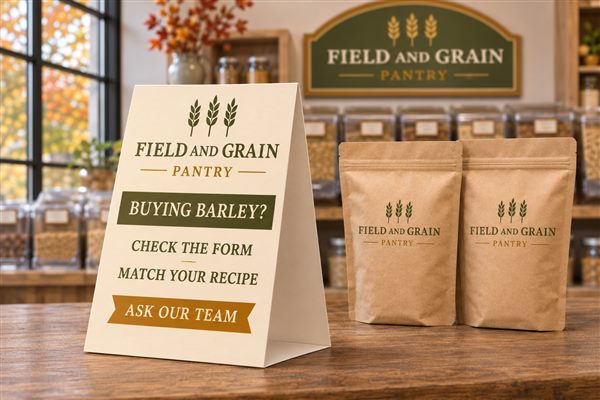
A small printed prompt for a dry indoor counter
DecentCustom’s custom table tents are listed as 5 × 7 inches, with 14pt card stock and full-color printing. The folded paper format stands without a separate holder.
The page lists glossy as the default finish and matte as an option. Confirm the finish, artwork and quantity for your intended location; the matte appearance shown here is a concept. This is printed paper, not a grain container or a promise of food-contact or weather resistance.
Compare other formats in custom marketing materials, or explore custom products from DecentCustom for broader shop needs.
A useful grain description gives customers a reliable name to take home. Keep the variety, processing and recipe form clear, and there is less left for the shopper to guess.