
A practical holiday merchandising guide for independent neighborhood grocers.
Grocery store gift baskets can solve a useful neighborhood shopping problem: finding a small, ready-to-give present without making another stop. The opportunity is strongest when the contents make sense for the recipient and the price is easy to understand.
Below are three starting concepts, a completed cost example and a simple trial record. These are planning tools, not evidence that your customers want a gift-basket service. If individual products or a gift card better suit them, keep that option visible.
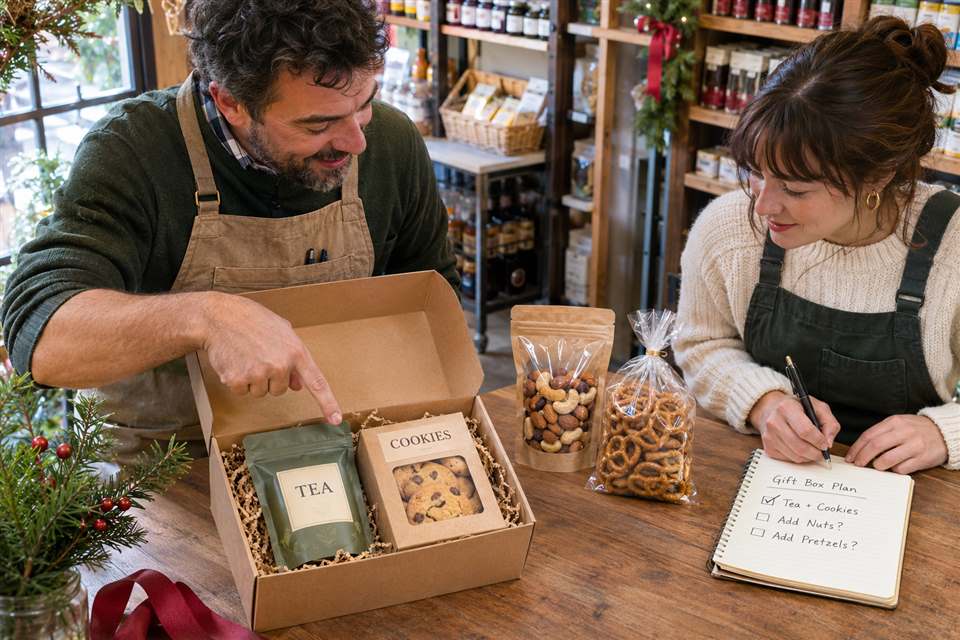
A useful gift feels selected, rather than filled
Several grocery retailers already organize gift ideas around recognizable interests. Whole Foods Market’s gift-basket guide starts with a theme, while Lucky’s Market’s holiday guide includes a local Colorado selection. Those are merchandising examples, not proof of demand at your shop.
Recipient preferences can differ sharply. In a public discussion about inexpensive gift baskets, the maker describes selecting items for people they know, while other participants prefer a single favorite treat over a collection of unwanted extras. It is one discussion, with unverified participant identities, but it offers a useful question: would this person choose each item if it were sold separately?
Three grocery gift concepts to adapt to your shelves
Choose products you actually stock and know how to handle. Show the brands, package sizes and exact contents. Keep the original ingredient, allergen, storage and date information available; decorative packaging should not hide it. Do not describe a bundle as suitable for a dietary need unless the specific products and your process support that claim.
A small thank-you: tea and cookies
Who it might suit: a shopper thanking a host or neighbor whose tastes they know. Pair one packaged tea with one complementary packaged cookie product. Offer a message card and an appropriate outer container. Avoid adding a mug automatically: it changes the price, space and carrying requirements, and the recipient may already have enough.
A shared evening: a focused snack pair
Who it might suit: a shopper buying for a household that enjoys a particular type of snack. Start with two packaged products that work together. Ask whether the gift is for one person or for sharing before making it larger. A second flavor can be an explicit choice rather than an unexplained extra.
A neighborhood discovery: two named local products
Who it might suit: a shopper seeking something connected to the area. Choose products with a verified local maker or production connection and name that connection accurately. “Packed by our store” and “made locally” are different statements. If you cannot support a local-origin claim, describe the actual products without it.
A small shop does not need to launch all three. Choose the concept that fits its current assortment, staff time and actual customer requests. Keep any substitutions visible before a customer commits to the gift.
Count assembly time before setting the offer
A gift bundle uses more than its food contents. Include the outer packaging, identification or message materials and the time needed to assemble it. Keep existing operating costs in view when evaluating the remaining amount.
Completed example: a simple boxed thank-you gift
All numbers below are hypothetical planning inputs. They are not current supplier quotes, DecentCustom prices or recommended market prices. Replace every input with your own actual cost.
| Input per bundle | Illustrative calculation | Cost |
|---|---|---|
| One packaged tea | Assumed acquisition cost | $4.00 |
| One packaged cookie product | Assumed acquisition cost | $3.50 |
| Plain outer box | Assumed material cost | $1.20 |
| Message card and identification | Combined assumed cost | $0.30 |
| Assembly time | 5 minutes × $18/hour ÷ 60 | $1.50 |
| Total listed direct cost | $4 + $3.50 + $1.20 + $0.30 + $1.50 | $10.50 |
At a hypothetical $15 selling price, $15 − $10.50 leaves $4.50 before other costs. That is not net profit. Payment fees, overhead, damaged or unsold materials, discounts and any delivery expense have not been included. Handle tax according to your actual obligations and accounting treatment.
This example assumes a plain box. If you add a custom tote or change the packaging, replace the cost and assembly-time inputs. Do not quietly absorb the extra item into a price calculated for something else.
Build the sample as staff would during a normal shift and time the work. If it is awkward to assemble, simplify the arrangement before increasing quantity. An attractive photo alone does not tell you whether the offer is manageable at the counter.
Choose the container after measuring the finished gift
Measure the actual packaged contents together, including any protective materials you need. Check the opening, base, height and the way the gift will be carried. For a customer collecting in store, a simple box may be enough. Shipping introduces a different protection task; an attractive retail gift presentation is not a verified shipping pack.
| Option | Useful when | Check before buying |
|---|---|---|
| Existing plain box or bag | You are testing the offer or need a small quantity quickly | Fit, presentation, carrying and actual availability |
| Plain container plus custom label | The container works and you want consistent fixed store information | Label size, material, placement and order unit |
| Custom grocery tote | The recipient has a use for the bag and its cost fits the offer | Contents fit, imprint area, sample handling and delivery timing |
Compare custom grocery bags by their actual construction and dimensions. Do not choose a bag just because its picture looks approximately the right size.
Use a label for a clear message, with room for a personal note
A fixed store name and a short thank-you message can work across several gift occasions. Leave the recipient’s name and personal message on a separate card, so one permanent print run does not lock you into a single holiday date.
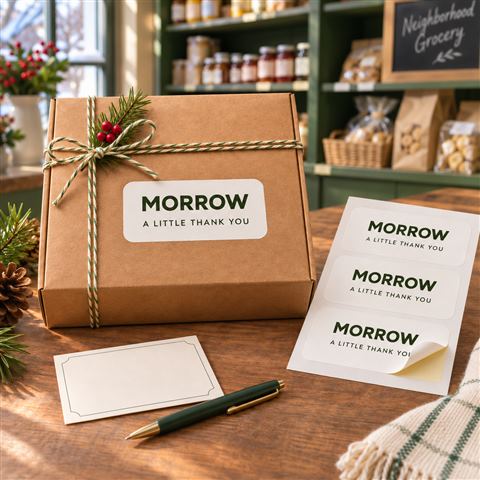
DecentCustom’s custom labels for gift packaging have configurable sizes, shapes and materials. Confirm the selected labels-per-sheet arrangement and total label count: a sheet is an order unit, not necessarily one label.
Try the chosen label on the actual box or bag before committing. Check placement, legibility and adhesion under your own conditions. The AI concept is not evidence of physical performance. Keep the decorative message separate from required product information.
A reusable carrying option should earn its place
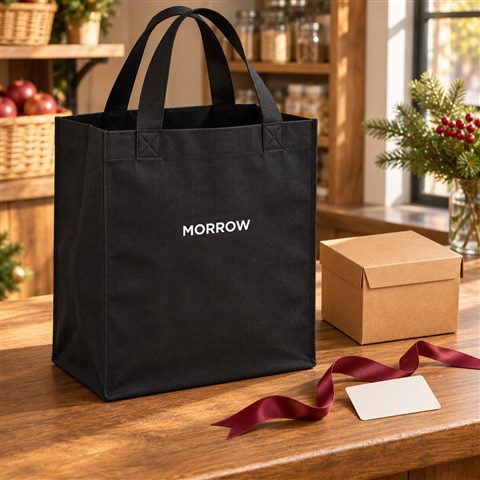
The linked custom non-woven grocery tote measures approximately 13 inches wide × 15 inches high × 10 inches deep and has an open main compartment with an inner bottom board. Its listed print area is 5 × 8 inches. A small readable store mark fits a different design task from printing the entire front.
Use a sample to check your real contents and handling. The dimensions are not a load rating, and the tote is not presented as insulated packaging. Check the selected order quantity separately from case-pack information and verify the required arrival date before ordering. If it does not suit the gift, keep the simpler container.
Try a limited offer and record why people choose—or decline—it
Set a trial limit around confirmed product availability, free storage space and the team’s assembly capacity. Put one sample and a plain contents list where interested shoppers can examine them. State the current price, what is included and how collection works. Do not imply that an unconfirmed large order can be fulfilled.
A trial record you can copy
Illustrative observations, not real customer results:
- Shopper A: chose the tea-and-cookie gift for a neighbor; wanted a blank message card.
- Shopper B: declined the bundle and bought the tea alone; did not need the cookies.
- Shopper C: asked for a different cookie product; staff needed to check availability before confirming.
These three examples suggest different actions: retain the message space, keep individual products available and define how approved changes are recorded. They do not establish a conversion rate or predict demand.
In your real record, note the date, concept shown, purchase or decline, stated reason when volunteered, assembly time and any unused materials. Avoid collecting unnecessary personal details. Review those observations before reordering custom supplies. If the concept does not resonate, change or stop the offer rather than adding more packaging to it.
Questions before a larger order
Does the gift need a traditional basket?
No. Choose the container around the products, carrying requirements, recipient and cost. A plain box or suitable bag may work better for a small trial.
Should we hide the individual product prices?
Explain the complete gift price and exact contents clearly. Presentation and assembly add work, but customers should understand what they are buying. Keep product information and your normal pricing policies accurate.
When should we order custom packaging?
After the sample, actual cost and intended use are clear, and only when the product’s order conditions and arrival timing fit your plan. Plain supplies are a valid option for the immediate trial.
Make the gift useful before making it more elaborate
A small grocery gift can succeed as a thoughtful selection without a large assortment or complex wrapper. Start with products the recipient would want, make the complete offer clear and test the work involved. When consistent branding or a carrying option serves that plan, explore custom products from DecentCustom and check the exact specifications before purchasing.
The retailer examples and public discussion inform the planning approach. All cost figures, trial observations and MORROW scenes are illustrative. No actual store sales, customer outcome or physical product test is claimed.