
Food cooperatives · Ownership communication
“Do I have to join to shop here?” and “Why would I become an owner?” are different questions. A food co-op can answer the first in a sentence and still leave the second unclear. Add assumptions about work shifts, discounts or household membership, and an interested shopper may struggle to understand what joining actually means.
Separate permission to shop from becoming an owner. Then explain the co-op’s actual contribution or fees, voting rights, work expectations, benefits and relevant conditions. These details vary between co-ops, so a generic “everyone can shop” or “all members volunteer” message can mislead.

The useful answer may help someone decide not to join
In a Bellingham shopper discussion, a person new to the area describes asking an employee whether joining the co-op would be worthwhile. In a later comment, the shopper says a brochure helped explain the benefits, but their expected shopping frequency made joining less appealing; they still expected to visit occasionally.
That is one person’s account, not a survey of co-op shoppers. It offers a valuable standard for outreach: an explanation can work even when it does not produce an immediate membership application. The shopper should understand the choice.
For a holiday community table, store introduction or ownership conversation, lead with the questions people are actually trying to answer. Explain the cooperative purpose alongside the practical terms. A warm welcome and a complete answer belong together.
Three real examples show why a universal script fails
These examples come from the operators’ own FAQs, reviewed in November 2026. They illustrate different models; they are not recommendations or a complete comparison of membership agreements.
| Co-op | Shopping access described in its FAQ | Work expectation described |
|---|---|---|
| Portland Food Co-op, Maine | Ownership is not required to shop. | No work shift or volunteer expectation for shopping. |
| Sugar Beet Food Co-op, Illinois | Open to the public. | Owners are not required to work or volunteer. |
| Park Slope Food Coop, New York | Only members may shop. | A member-work model, with stated exceptions. |
A visitor who knows one model may reasonably expect another store to work the same way. Put your own answer near the entrance and on the membership page. If shopping is open to everyone, say so directly. If membership is required, explain the next step without using a public-shopping message borrowed from another co-op.
Start with the shopper’s question, not the application form
A useful opening is: “Are you wondering whether you can shop today, or whether ownership would be right for you?” The reply tells the employee which explanation to give.
For someone asking about ownership, describe what the contribution supports, how owners participate and the benefits actually offered. The Food Co-op in Port Townsend, for example, presents governance and responsibilities alongside its owner benefits. That is a useful reminder to explain participation as well as promotions.
Then ask which detail the shopper wants to understand: the payment arrangement, voting, household use, work requirements or a specific benefit. Offer the current written explanation to take home. Avoid promising that membership will pay for itself; the shopper’s needs and the co-op’s actual terms matter.
Keep the condition next to the benefit
“Owner savings” is a headline, not a complete explanation. If a benefit applies only to designated products, a particular period or a qualifying order, put that condition beside the benefit. Distinguish a current discount from a possible future patronage distribution. Do not describe a conditional benefit as something every owner receives automatically.
The same care applies to joining and leaving. Separate an ownership contribution from any joining fee or recurring charge your co-op actually uses. If withdrawal requires a request or approval, do not reduce that explanation to an unconditional “money back anytime” slogan. Co-opportunity’s FAQ, for example, places a Board-approval and risk qualification alongside its withdrawal information.
Use the current agreement for the amounts, eligibility and conditions, with a clear way to obtain it before applying. This is about presenting the co-op’s terms accurately; a promotional handout should not rewrite them.
A completed example for a fictional public-shopping co-op
The following FERN example assumes a co-op where shopping is open to everyone, ownership is optional and no owner work shift is required. Those are fictional policies for the example, not rules for all co-ops.
Can I shop without joining?
Yes. Everyone can shop at FERN. Becoming an owner is optional.
What changes if I become an owner?
You help support our community-owned store and can participate in Board elections under our bylaws. Our current ownership information sheet explains the benefits and their conditions.
Do I need to work a store shift?
No. FERN does not require an owner work shift. Ask us about other ways to participate if you are interested.
What should I read before applying?
Ask our information desk for the current contribution and fee details, any payment options, benefit eligibility and withdrawal terms. You are welcome to take the information home before deciding.
This gives a staff member a complete short explanation without inventing prices, discounts or refund guarantees. For your own version, replace the fictional answers with your co-op’s actual policies. Make sure a shopper can find the detailed terms the short answer refers to.
Questions that deserve more than a sales pitch
“Is ownership just another loyalty card?”
A food co-op’s ownership model includes participation in the business, rather than only tracking shopping rewards. Explain the actual voting or governance role described in your bylaws, then describe discounts separately. Supporting the store’s purpose may matter to a prospective owner even when a particular coupon does not.
“Does everyone in my household get a vote?”
Do not assume that shared shopping benefits mean shared voting rights. Portland Food Co-op’s FAQ, for example, distinguishes household shopping benefits from the individual Member-Owner’s ability to vote or run for its Board. Explain how your own co-op defines an owner, a household and eligibility to participate.
“Will joining always make my groceries cheaper?”
No blanket savings promise is appropriate. Explain the exact benefits and conditions your co-op offers, and let the shopper consider how they would use them. Public shopping, owner-only offers and patronage arrangements are different things. Someone who visits occasionally may reasonably prefer to keep shopping without joining where that option exists.
“Can I take the information home and decide later?”
A useful outreach conversation gives the person a current written explanation and a named place to ask follow-up questions. Clarify any actual application or offer deadline rather than inventing urgency. A decision that fits the shopper’s circumstances is more valuable than an application based on a misunderstanding.
Use a presentation folder when there are several documents
A single FAQ sheet or existing brochure may be sufficient for a short conversation. A folder becomes useful when an orientation includes several separate pieces: the plain-language FAQ, current ownership terms, an application and information about participation. Keep the detailed documents replaceable instead of printing changing terms permanently on the cover.
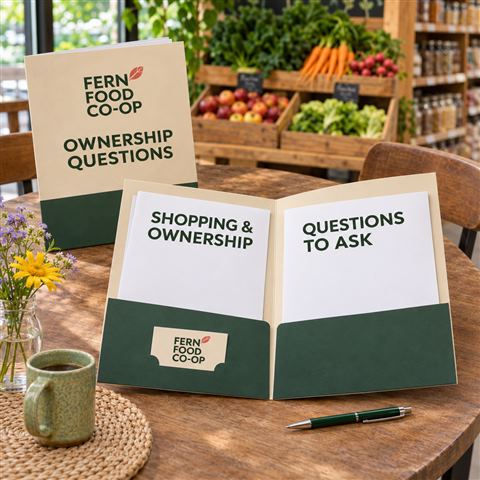
A branded cover for a clear, replaceable information packet
DecentCustom’s 9 × 12 inch custom presentation folders list full-color printing, inside pockets and a business-card slot, and are described as suitable for standard 8½ × 11 inch documents.
The page lists 14pt paper and glossy stock as defaults, with 16pt and matte options. Confirm the selected stock, pocket artwork, finished quantity and proof. The observed quantity field was 100; that observation alone does not establish a firm minimum or a final quote. Prepare the information sheets separately.
Compare other custom marketing materials if a smaller printed format fits the conversation better. A more elaborate packet is not automatically a more helpful one.
Check whether the explanation answers the decision
Before printing more, give the draft to someone who did not write it. Ask them who may shop, what joining changes, whether work is required and where the full terms can be found. If an answer depends on an assumption, revise the wording or add the missing condition. This is a suggested review method, not a completed reader test.
Once the explanation is clear, explore custom products from DecentCustom for the format that suits your outreach. The useful part of the packet is the honest answer inside it.