
Discount grocery · Shelf communication
A low package price is only part of the answer at a discount grocery store. A customer comparing two bags of rice also needs to know the pack size, the cost for the same quantity, and whether any conditions apply. When the next delivery brings a different size, yesterday’s shelf card may no longer describe today’s deal.
Identify the exact item and net quantity, show the selling price, and make the unit price easy to compare using the same unit for similar products. Keep promotional conditions beside the relevant price. Use a separate, reusable brand message so a changing deal does not leave a permanent sticker carrying an outdated price.
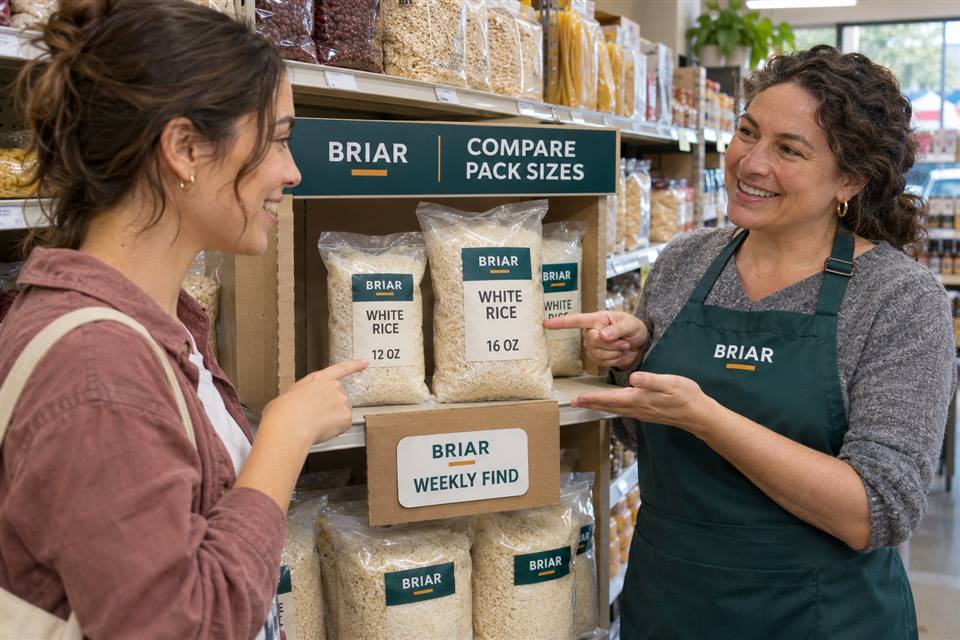
The shopper’s question: “Is this particular item a good deal?”
“Discount” does not remove the need to compare. In one Grocery Outlet shopper discussion, participants describe looking for individual finds and seeing favorites disappear; others still report good local deals. That is one discussion, not a representative price survey. The useful lesson for an independent store is to make each offer understandable on its own.
This matters when someone is planning a holiday meal with a fixed amount to spend. A larger pack can offer a lower cost per ounce while requiring more money at checkout. A clear shelf comparison lets the customer choose between those two priorities without an employee having to defend a blanket “best value” claim.
A worked comparison: lower unit cost, higher payment today
Start with genuinely comparable products. For this illustration, assume two packs of the same kind of plain dry white rice. These are fictional prices, not current offers or a comparison between named retailers.
| Shelf information | Pack A | Pack B |
|---|---|---|
| Net quantity | 12 oz | 16 oz |
| Selling price for one pack | $1.50 | $1.76 |
| Calculation | $1.50 ÷ 12 oz | $1.76 ÷ 16 oz |
| Unit price | 12.5¢ per oz | 11.0¢ per oz |
| What the customer can choose | Lower payment today | Lower cost per ounce |
Pack B costs 26¢ more today: $1.76 − $1.50 = $0.26. It provides four more ounces and a lower unit price. Pack A still makes sense for someone whose immediate spending limit is $1.50 or who does not need the larger quantity. Neither shopper needs to be told they are choosing incorrectly.
The formula is selling price ÷ net quantity = price per unit. Convert dollars to cents if that is the chosen display format, then round consistently. The University of Tennessee’s shopping guide explains the calculation and cautions that larger packages are not automatically cheaper per unit.
Use the same unit across comparable items. Do not make shoppers mentally convert one card from dollars per pound while the next uses cents per ounce. The NIST Unit Pricing Guide provides best-practice guidance on consistent comparison units, readable labels and sale-price information. Its guidance does not replace the pricing requirements that apply in your location.
Put the comparison where the product sits
A large “WEEKLY FIND” header can identify a display. The card immediately below each product should do the detailed work. Here is a completed example for Pack A:
$1.50 each
12.5¢ per oz
Fictional example. Place the corresponding 16 oz card directly below Pack B, showing $1.76 each and 11.0¢ per oz.
Match the card to the actual brand, variety and pack size. Keep the product identifier available for staff, but do not let internal codes crowd out the information a shopper needs. Look at the display from a normal browsing position: can someone tell which card belongs to which bag?
If an offer requires buying several packs, a membership or a coupon, place that condition with the price it qualifies. Do not use a bare “2 for…” message when the customer cannot tell the price for one or whether two are required. Confirm the actual offer first; attractive artwork cannot resolve an undefined promotion.
When a find changes, treat the replacement as a new item
A similar-looking bag is not necessarily the same offer. Suppose the next delivery replaces the 12 oz rice with a 10 oz pack. Keeping the old $1.50 / 12.5¢ per oz card would associate the wrong quantity and calculation with it. Verify the replacement’s net quantity and selling price, calculate its unit price again, and put the matching card in place before displaying it under that offer.
For an item with uncertain replenishment, an honest shelf message is more useful than an invented return date: “Current stock only. Ask us about today’s alternatives.” Use that wording only when it describes your actual offer. If a delivery is confirmed, staff can explain the expected availability while making clear that the replacement may differ in size, brand or price.
A simple change record is enough: item identifier, old card removed, replacement size and price checked, new calculation checked, date and staff initials. Your existing shelf-label or point-of-sale system may already support this. Use it rather than creating a second competing set of prices.
Where custom labels help—and what they should leave changeable
Keep stable branding and changing prices separate. A small BRIAR “WEEKLY FIND” label on a dry display card can give recurring offers a consistent appearance. The exact item, pack size, selling price and unit price belong on a replaceable card beside it. A brand label helps identify the display; it does not calculate prices or keep inventory current.
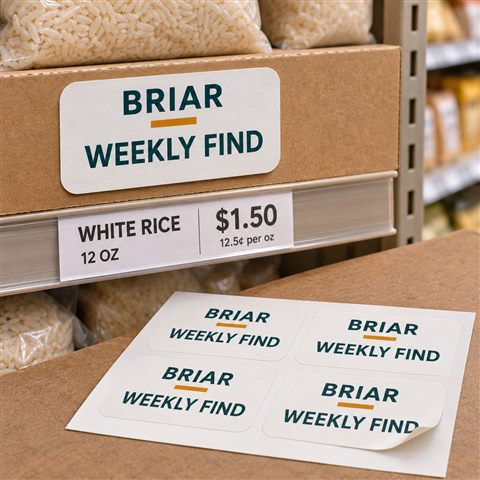
A product to consider for the fixed brand element
DecentCustom’s custom product labels list paper, rounded-rectangle shapes, full-color printing and matte options. A paper label for the fixed store message is one configuration to discuss; the separate price ticket can remain an ordinary printout.
The listing describes the package in sheets. Confirm the finished label size, labels per sheet, quantity unit, material and proof before ordering. A quantity of one should not be assumed to mean one individual label. Check suitability on your actual display surface; this concept does not demonstrate cold-storage use, water resistance, clean removal or direct food contact.
Compare formats in the custom labels and stickers category if the application calls for a different format. For a short trial, plain paper and an existing holder may be all you need. Approve the message and placement before investing in a larger printed batch.
Customer questions your team can answer clearly
“Is everything here cheaper than at another grocery store?”
Compare the particular product, quantity and current offer rather than promising that every item is cheapest. A useful reply is: “Here is our price and pack size. This card shows the price per ounce so you can compare a similar product.” If a customer shows a competing offer, check whether the size and conditions match before discussing the difference. One attractive find is not proof that an entire basket will cost less.
“Should I always buy the bigger pack?”
No. Check its unit price first, then whether the total fits your budget and the quantity fits your needs. In our fictional example, the 16 oz rice costs less per ounce but requires 26¢ more today. Rutgers’ unit-pricing guidance also places the comparison in the context of the shopper’s budget and ability to use or store the quantity. A lower unit price is useful information, not an instruction to buy more.
“Will this same bargain be here next week?”
Check the actual replenishment information. If it is unknown, say: “We have this item today, but I cannot confirm another delivery. I can show you the alternatives currently on the shelf.” Do not promise that a different brand or smaller pack will be the same deal. If a new shipment arrives, compare its own quantity, price and conditions before recommending it as a substitute.
Start with one display customers can understand
Choose a small group of comparable pantry products. Verify the pack sizes, use one comparison unit and ask someone to identify the lower payment today and the lower unit price from the cards alone. If they cannot, fix the information or placement before adding more promotional graphics.
Once that display works, explore custom products from DecentCustom for other store communication needs. Clear item information should lead the design: a recognizable brand is most useful when the customer can also understand the offer beneath it.