
BAKING INGREDIENT STORES · RECIPE FIRST
Buy the cocoa type your recipe specifies. Natural cocoa retains its natural acidity; Dutch-process cocoa has been treated with alkali to reduce it. Both can be unsweetened. A darker color, “100% cocoa,” or a premium label does not by itself tell you whether a powder matches your recipe.
At the baking ingredient store, the darkest cocoa can look like the obvious upgrade for a chocolate cake. But the cake’s ingredient list may say natural cocoa, while the tin says Dutch-process. Before choosing, open the recipe’s notes as well as its ingredient list. The right purchase starts with that specific bake.
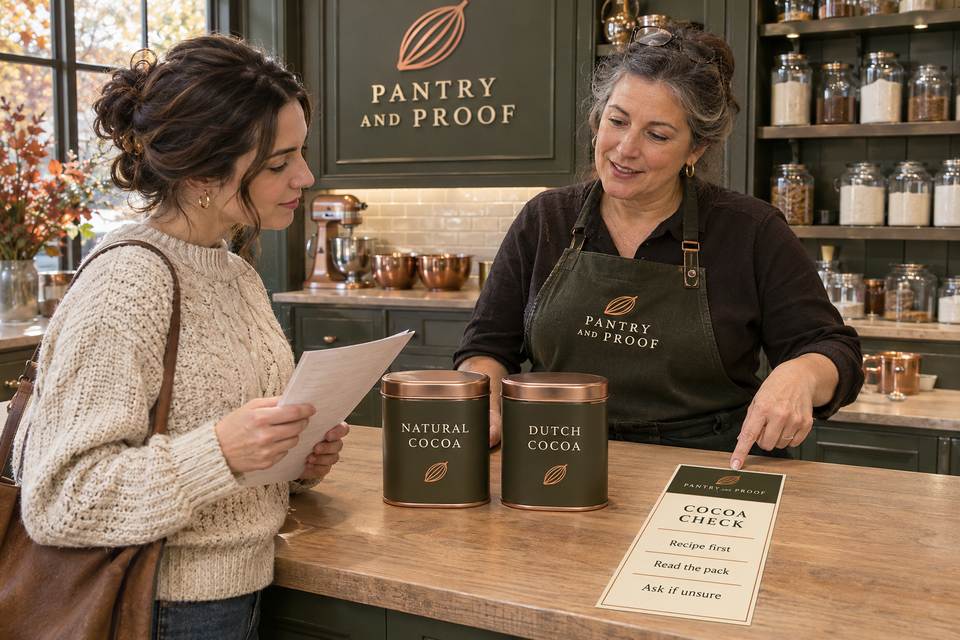
Natural and Dutch-process: what changes?
Sally’s explanation of natural and Dutch-process cocoa identifies both as types of unsweetened cocoa powder. Dutch-processing changes acidity; natural cocoa is acidic. That difference can matter in a recipe using chemical leaveners, so “unsweetened” is not enough information to choose between them.
King Arthur Baking’s cocoa comparison explains why recipes written for natural cocoa often include baking soda, while recipes for Dutch-process often use baking powder. Those are common patterns, rather than permission to rewrite a recipe by looking at just one ingredient. The full formula and its author’s instructions matter.
The two guides also allow more nuance than “these powders can never be swapped.” Some recipes explicitly permit either. Others specify one type. For a shopping trip, follow the recipe’s stated option instead of applying a generic substitution rule to every cake, cookie or brownie.
Separate three pieces of label information
| Label detail | Question it answers | What to check next |
|---|---|---|
| Natural or Dutch-process | Which processing type is identified? | Match the recipe’s wording; ask about “processed with alkali” if unclear. |
| Unsweetened / ingredients | What is the actual product? | Read the current ingredient list, not just the front-panel description. |
| A cocoa-butter specification | Is the recipe asking for a particular fat specification too? | Check the maker’s product specification; processing and fat content are separate details. |
A December 2022 forum question illustrated the confusion: its writer was trying to interpret a recipe’s “dark cocoa” and a percentage alongside the leavener. The useful response is to identify what each specification means, not to copy an unverified brand claim or calculate a precise cocoa specification from a rounded nutrition panel.
Guittard’s Cocoa Powder 101, featuring Alice Medrich, discusses processing, fat and color as distinct considerations. Its own natural and Dutch-process offerings illustrate why a fat specification alone does not name the processing type. Confirm the actual product data when a recipe specifies both.
A shopping decision for each recipe situation
| Your recipe says | Useful next step | Avoid this shortcut |
|---|---|---|
| Natural cocoa | Choose a product confirmed as natural. | Replacing it solely because another powder looks darker. |
| Dutch-process cocoa | Choose a product identified as Dutch-process or alkalized. | Assuming “100% cocoa” identifies the process. |
| Either natural or Dutch-process | Use one of those permitted options and keep track of the product. | Expecting identical color and flavor. |
| Only “cocoa” | Check the author’s notes, recommended product and replies; ask if necessary. | Inventing a substitution from one leavener alone. |
David Lebovitz’s cocoa FAQ emphasizes following the written recipe and describes an exception in his own Devil’s Food Cake recipe that permits either type. That is a recipe-specific instruction, not evidence that every cake will behave the same way.
Iowa State University Extension’s AnswerLine guide likewise explains that acidity and leavening can affect a substitution. Its practical takeaway here is to use the specified type. A shop guide should help you match that requirement; it cannot validate a reformulated recipe.
Two worked shopping decisions
These examples are fictional; they are not tested recipes or product offers.
Alex is buying for a birthday cake with explicit instructions. The recipe lists natural unsweetened cocoa and contains notes about that choice. Alex sees an appealing Dutch-process tin, but buys the product confirmed as natural instead. Alex saves its exact name with the recipe. The decision matches the instructions without changing leaveners or promising a particular result.
Morgan has an old recipe card that only says “cocoa.” No author notes or original product can be found. Morgan first asks the family member who supplied it, but they cannot clarify. Rather than guessing a conversion for an important bake, Morgan selects a different published recipe that explicitly calls for Dutch-process cocoa, which the store has. Morgan buys that identified product and keeps the complete new recipe. The uncertainty was resolved by changing to clear instructions, not by pretending the old wording was conclusive.
Bring this information to the ingredient counter
Fictional completed shopping brief
Project: Alex’s chosen birthday-cake recipe.
Recipe wording: natural unsweetened cocoa.
Pack to confirm: natural processing and current ingredient list.
Remember: exact product name and recipe source.
If unavailable: check an author-approved alternative before buying a different type.
Serious Eats’ pastry-chef guide discusses how ingredients balance in a leavened recipe. That supports bringing the full recipe rather than asking a store employee to infer the entire formula from “I’m making chocolate cake.”
For ingredient stores: make the question easier to ask
An accurate shelf label, current product specification and knowledgeable conversation may be enough. When a takeaway guide is useful, custom rack cards for baking ingredient stores can organize stable prompts: recipe first, read the pack, ask if unsure. Put your shop identity and a route to current product information on the guide.
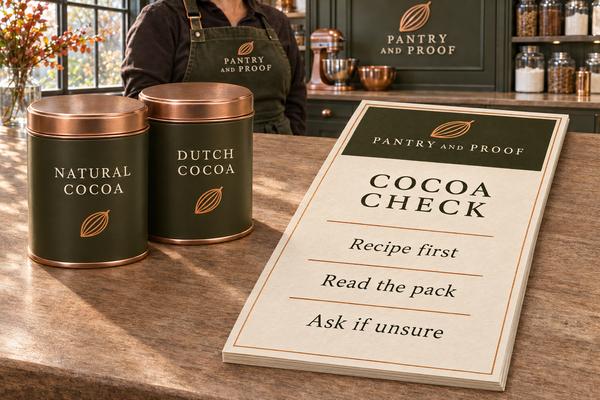
A printed prompt for a more useful conversation
DecentCustom lists a flat 3.74 × 8.27-inch rack card, with 14pt standard cardstock and glossy finish as default options. Other stock and finish combinations differ; a holder is not listed in the package.
Confirm the stock, finish, artwork, trim and bleed. If handwriting is intended, ask about the selected finish. Keep recipe-specific advice, changing product specifications and availability with their current sources.
Explore related custom marketing materials and other custom products from DecentCustom after deciding what information the customer needs to keep.
Cocoa shopping questions
Does “unsweetened” mean natural cocoa?
No. Both natural and Dutch-process cocoa can be unsweetened. Check the processing description and current ingredient list, or ask the maker to identify the exact product.
Is Dutch-process cocoa always an upgrade?
No. It has a different processing history and can give a different color and flavor. Match the recipe’s specified type; a darker powder is not automatically the right choice for every bake.
What if the recipe only says “cocoa powder”?
Check the original author’s notes, named products and replies. If the type remains unclear, ask the author or choose a recipe with explicit instructions. Do not assume that a single leavener settles the whole formula.
Sources and the linked print product were checked November 7, 2026. The forum example identifies a wording problem, not verified purchase behavior, popularity or a baking experiment. This guide helps with ingredient selection; it does not supply recipe-conversion ratios.