
CAKE DECORATING SUPPLY STORES · BUY FOR A PROJECT
Beginners do not automatically need both a Wilton 1M and 2D. The 1M is a large open-star tip; the 2D has a more closed opening and is often described as a closed-star or drop-flower tip. Both can make rosettes and swirls. Choose the look you want, check what you already own, and confirm the bag and any coupler fit the exact tip.
If your starter kit contains only tiny detail tips, a large cupcake swirl can feel frustrating. Buying the biggest assortment is one response, but it may leave you with more small tips and no clearer plan. Bring a picture or tutorial for one decoration you want to learn. That gives a cake decorating supply shop a specific problem to help solve.
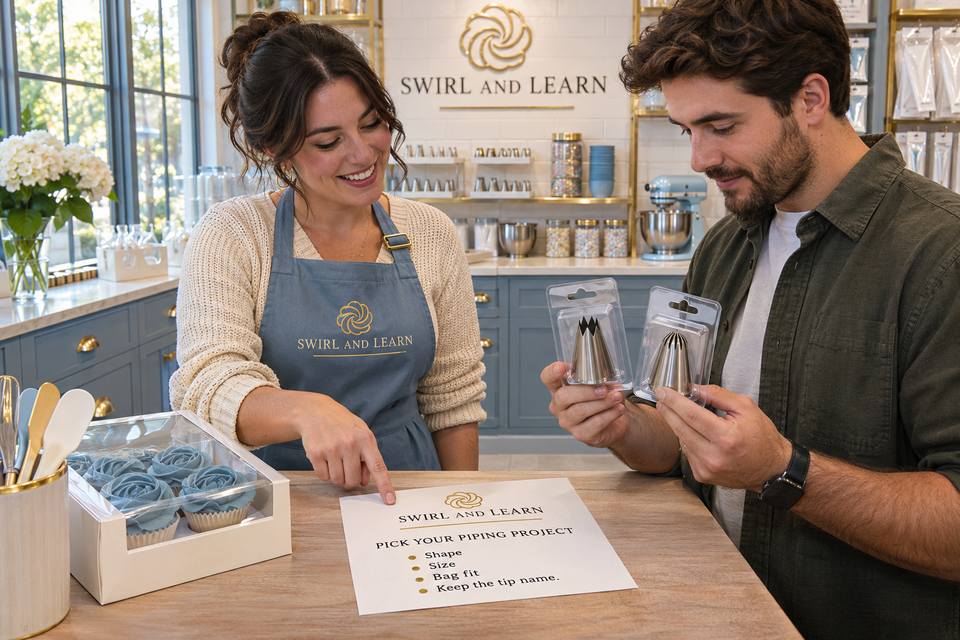
1M versus 2D: compare a look, not a winner
In her written 1M and 2D comparison, Cakes by Lynz describes the 1M’s classic swirl as more like an ice-cream swirl, while the 2D produces a softer, ruffled effect in her comparison. She prefers the 2D for a rose-like rosette. That is a useful description of her demonstrated designs and personal preference, not a promise that a new tool will reproduce them immediately.
Sally’s piping-tip guide shows an important counterexample to “one tip, one effect”: her Wilton 1M is used for both a flat rose and a tall swirl. She also discusses similar looks from other star tips, with different widths. If you already own a 1M, the next step may be learning another movement with it rather than buying another nozzle.
Start with the decoration you want to make
| Your project | What to compare | Before buying |
|---|---|---|
| A tall cupcake swirl | A large tip matching the tutorial’s opening and scale. | Ask whether your existing tip can make that effect. |
| A flat rosette | The tutorial’s actual star or flower tip and finished texture. | Remember that both 1M and 2D can make rosettes. |
| Small writing or dots | A suitably sized round opening. | Do not assume a large star tip replaces a detail tip. |
| A class with a supply list | The exact brand, number and required accessories. | Ask the instructor before substituting another shape or size. |
The Cake Decorating Company’s beginner guide organizes tips by families such as round, star and drop flower. It also explains that frosting texture and technique affect the result. A different nozzle is not the only possible response when piping looks unlike a reference photo.
Keep the brand and number together in your notes. When considering another brand or an unnumbered kit, compare its actual opening, size and the technique you intend to follow. A description such as “star tip” is a useful family name, but does not establish identical scale or bag compatibility.
Check the bag and coupler as a set
A coupler can make changing tips on the same bag easier, but it is not an automatic requirement for every setup. Wilton’s starter guide says its tips can be used directly in a decorating bag and distinguishes standard and large couplers. It also warns that not every tip is designed for a coupler. Check the exact combination rather than treating “standard” as a universal fit.
At the store, show the package or bring the clean, empty tool you already own if the shop allows it. Ask: “Does this bag work with this tip, and if I want to change tips, which compatible coupler do I need?” Follow the maker’s instructions for assembling that specific system. Buying an accessory with an unfamiliar base or ring is not the same as confirming the fit.
Two sensible beginner purchases
These examples are fictional. They illustrate equipment decisions, not tested piping results or current store offers.
Rowan already owns a Wilton 1M and wants rose-like cupcake tops. Rowan initially plans to buy a 2D because a photograph shows rosettes. After reading a tutorial that uses a 1M for that decoration, Rowan keeps the existing tip and follows that tutorial first. A 2D remains an option later if Rowan wants its different effect. The immediate choice is to learn a use for an owned tool, not to assume the first attempt proves a second tip is necessary.
Taylor’s class specifically lists a Wilton 2D. Taylor owns only tiny detail nozzles and wants to follow the instructor’s exercise. The shop identifies the specified tip and suitable bag. Taylor asks about a coupler; because compatibility has not been confirmed for the accessory brought from home, Taylor does not buy a random ring as a supposed match. Taylor buys the identified tip and bag, then checks the instructor’s setup instructions before class.
Why starter lists do not all contain the same tools
Gloria’s starter-kit article proposes four particular tips, while Baking Pleasures’ Australian beginner guide recommends a small, purposeful starting assortment. These are useful examples of different retailers’ approaches, not a universal list or evidence that any fixed set covers a measured percentage of everyone’s projects.
A May 2026 forum question made the practical gap clear: the writer wanted cupcake tops and basic cakes but owned only very small tips. Commenters described different personal tool collections. Those accounts help identify a question to answer; they do not establish which brand every beginner should buy or how often a typical customer uses a kit.
A shopping brief worth keeping
Fictional completed project brief
Project: Rowan’s first flat cupcake rosettes.
Already owned: Wilton 1M and the matching bag setup.
Reference: a tutorial demonstrating a rosette with that tip.
Buy now: no additional nozzle for this exercise.
Revisit later: compare a 2D if a different effect becomes the next project.
After practicing, record what you used and the question you still have. A photo of your own attempt plus the exact tip name gives a tutor or store employee more to work with than “my frosting looks wrong.” It also helps separate a missing tool from a skill you can keep practicing.
For supply shops: a takeaway project card
A tutorial link, staff explanation or ordinary note may be sufficient. If customers want a branded reminder, custom postcards for cake decorating supply stores can carry project prompts and a route to your current classes or tool information. Keep the guide focused on the customer’s next exercise rather than a long list of things to buy.
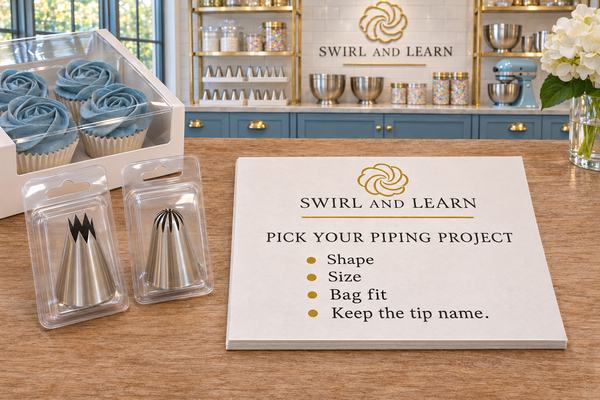
A paper reminder to take home
DecentCustom lists horizontal 6 × 4-inch postcards, with 16pt premium stock and glossy front only as default stock and finish. Other sizes, stocks and finishes have separate options. This concept is an ordinary flat paper card, not a piping mat or edible print.
Confirm the size, stock, finish, artwork, trim and bleed. Check the selected surface if customers will write on it. Keep current class dates and changing tool compatibility with their original sources.
Explore related custom marketing materials and other custom products from DecentCustom after deciding what the customer needs to remember.
Beginner piping-tip questions
Do I need both 1M and 2D to start?
No automatic requirement applies. Pick a specific decoration and follow a tutorial for the tip you have or plan to buy. Add another tip when you want a different effect or your class requires it.
Can a 1M make a rosette as well as a tall swirl?
Yes. Sally’s guide uses a Wilton 1M for both effects. The movement, frosting and scale still matter; owning the tip does not guarantee a particular finished result.
Will every large piping tip fit a standard coupler?
Do not assume so. Check the maker’s compatibility information for the exact tip, bag and coupler. Some setups use the tip directly in a bag, and not every tip is designed to work with a coupler.
Sources and the linked paper product were checked November 7, 2026. Forum comments are self-reported experiences, not a buyer survey. AI images are illustrative; no physical piping, food-contact or printing test is claimed.