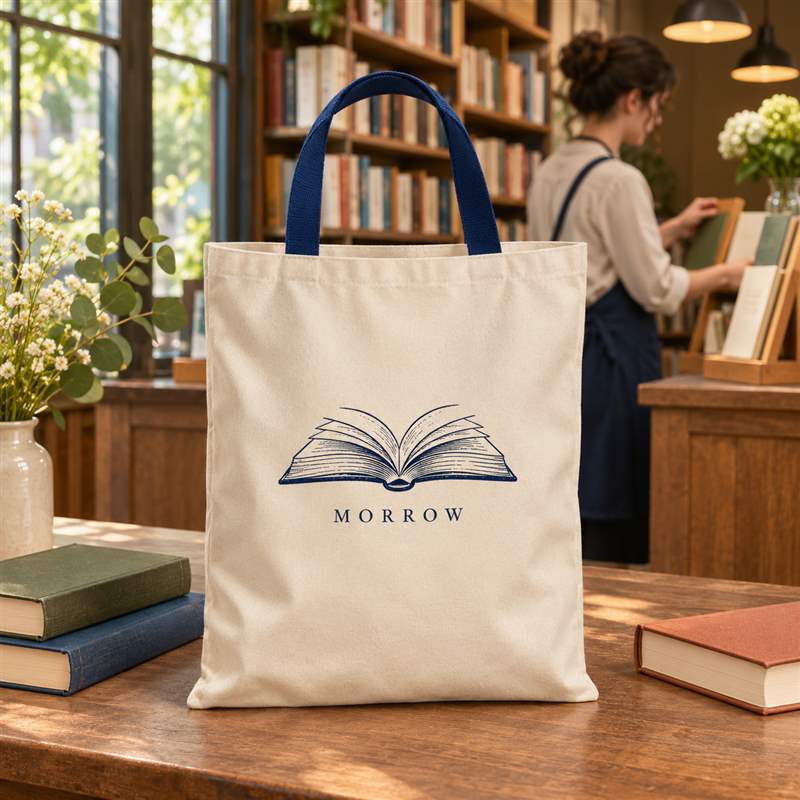

Custom merchandise · Small-business guide
Give people a reason to choose your bag—and a design they can enjoy after they leave your shop or event.
A bookstore owner, a market vendor and an event organizer can order the same blank tote and need completely different designs. The bookstore wants merchandise readers choose for themselves. The vendor needs a bag that suits the purchase. The organizer needs something attendees can use during the day.
The most useful custom tote bag ideas start with that job. Choose the bag around what it must carry, then build the artwork around the person who will carry it. A good-looking mockup cannot fix the wrong size or a message nobody wants to wear.
Nine tote bag design ideas, matched to a real business task
These are concepts to adapt, not a ranking of bestsellers. The scenes use the fictional name MORROW to illustrate design choices; they do not show customer orders or tested finished products.
1. A signature illustration for bookshops and creative stores
Give the customer a picture they would choose even without a promotion. For a bookstore, try an original open-book drawing with a small shop name beneath it. For a pottery studio, use the outline of a distinctive vessel. One recognizable subject gives the design a clear focus.
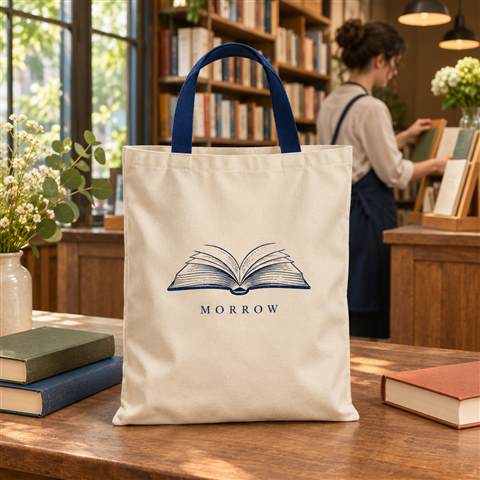
Make it useful: compare the bag with the actual books, boxes or items you expect people to carry. Check thickness and the opening as well as width and height. A flat tote’s listed dimensions do not guarantee that a bulky stack will fit.
Change direction if: the artwork depends on tiny titles, intricate lettering or someone else’s book-cover art. Simplify the drawing and use artwork you own or have permission to reproduce.
2. A product-inspired motif for retail and market stalls
Translate what you sell into a simple visual. A plant seller might choose one botanical sprig; a stationery shop could use a pencil-and-paper motif. Place the business name below the image so the tote feels connected to the store without turning it into a full catalog.
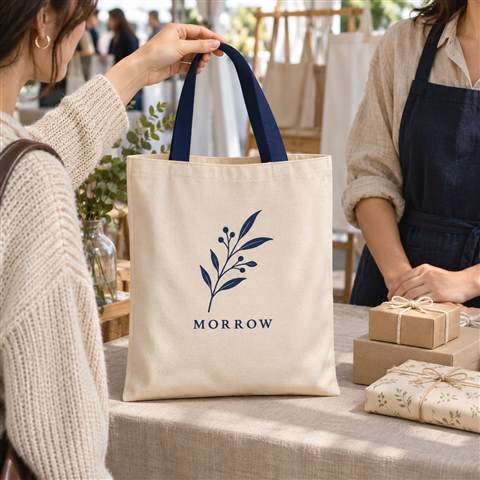
Make it useful: decide whether the tote is packaging, optional merchandise or a gift with a qualifying purchase. Those are different offers. Tell customers which applies, and offer the bag only when it suits what they bought.
Change direction if: the purchase is wet, fragile, unusually heavy or needs temperature control. Choose packaging designed for that task rather than assuming a cotton tote provides protection.
3. A quiet wordmark for welcome kits and appointments
A simple business name can work when the contents already explain the relationship. Think of a studio introducing its services or an organization preparing a welcome packet. Use one clear wordmark with generous space around it, rather than reproducing every line of your website header.
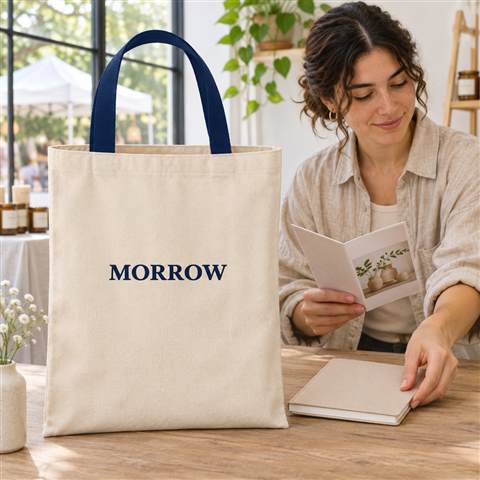
Make it useful: put changing details, appointment instructions and full contact information on an insert. Keep the bag’s message relevant after those details change.
Change direction if: recipients need a secure closure, weather protection or space for equipment. Select a different bag construction; a printed wordmark does not add those features.
4. A neighborhood detail for local businesses
Commission a simple drawing of your storefront, a familiar street corner or a local landscape. Pair it with a small business name. This gives residents and visitors a connection beyond the logo. Keep the design specific to your location, and check permissions for any supplied artwork before printing.
5. A short phrase tied to the customer’s routine
Write something your audience might say: “Make room for a new story” for a reading-themed shop, or “A little time to make” for a craft studio. These are starting concepts to adapt and check before commercial use. Let the phrase lead and the brand sign off underneath. Test whether a customer would still choose the message without a discount.
6. A small collection of tools for makers and workshops
Arrange a few recognizable tools in a compact composition: scissors, a spool and a needle for a sewing workshop, for example. Keep lines substantial enough for the selected printing process. Use accompanying class materials for detailed instructions instead of trying to print a whole lesson on fabric.
7. An event emblem with a life beyond the event
Build a graphic around the community or subject, then add the event name as a secondary element. Decide whether the date matters: a milestone may deserve one, while a recurring club might prefer a design that can be reused. Keep session schedules and room numbers on an insert so an agenda change does not make the bags incorrect.
8. A contained pattern for design-led brands
Use an original geometric or botanical pattern inside a defined front panel. The illustration can feel expressive without covering the seams or handles. This is a practical alternative when the chosen tote supports a limited front imprint rather than all-over printing. Leave enough clear space for the brand name to remain readable.
9. A seasonal motif without a short-lived sales message
For a seasonal store collection, try a simple branch, star or abstract shape that suits your brand. Put the temporary offer on a separate insert. If you print a year or sale date on the tote, order with that limited use in mind; leftover dated stock may be harder to use next season.
Choose the bag before finalizing the design
The illustrated product example is DecentCustom’s 13-inch-wide × 15.5-inch-high natural cotton tote. The current listing describes 7–8 oz. natural cotton and a maximum logo area of 9 × 11.3 inches. Confirm the selected color, printable area and artwork placement for your order; the body size is not the printing size.
If you need a different size, closure or bag construction, compare custom tote bags before adapting the artwork. Review the selected product’s dimensions and features against your actual contents.
| Check | What to do before ordering |
|---|---|
| Actual contents | Measure the widest item and the full packed thickness. Do not assume a laptop, large gift box or book stack fits from a flat dimension alone. |
| How it will be carried | Check handle dimensions and comfort for the intended person and use. Ask about closure or reinforcement if the task needs them. |
| Fabric and print | Review available fabric, color and printing options together. Cotton is a fiber; canvas describes a fabric construction, so the labels can overlap. |
| Evidence | Ask whether a relevant sample or physical print check is available, what it costs and how it affects timing. A screen preview is not a physical color or durability test. |
Do not buy another tote just because it is a familiar giveaway. If your recipients already have suitable bags, an optional pickup can be more considerate than handing one to everyone. In public discussions, some people value useful totes while others describe an excess of bags they rarely use. That disagreement is a reason to ask your audience, not to assume universal demand.
Five artwork checks that prevent an attractive idea becoming a weak print
- Choose one visual priority. Decide whether the illustration, phrase or logo should be noticed first. Remove details that compete with it.
- Use the selected product’s template. Keep the artwork within its confirmed imprint area. An all-over competitor mockup is not a template for a front-print tote.
- Review the file at intended print size. Inspect thin lines, small text, low contrast and image sharpness. Request the required file format and resolution rather than relying on a screenshot of the logo.
- Check the printed side and color expectations. DecentCustom’s stated default includes one-sided full-color printing. Confirm the selected SKU and any exceptions before approving. Your artwork can use a restrained palette even when full color is included.
- Give one person final approval. Check spelling, the correct logo version, placement and any variable names or dates. If individual personalization matters, confirm whether it is available and how files are supplied; do not assume every bag can differ.
A library buyer’s discussion provides a practical example: a commenter described having to adjust lines that were too thin for the printing process. That is an individual account, not a test of this product, but it makes the value of artwork review clear.
Copy and complete
A custom tote bag order brief
Send these details together so the supplier can check the whole job.
- Purpose and recipient
- We need the bag for ______. The person using it is ______.
- Contents and bag configuration
- It must accommodate ______, measuring ______ including thickness. Product/color: ______. Closure or other required features: ______.
- Design and print
- Main element: ______. Final artwork file/version: ______. Printed side(s), dimensions and placement: ______.
- Quantity and budget
- Required allocation: ______. Confirm minimum quantity, available increments and total cost including any selected options and delivery.
- Arrival and approval
- We need it in hand at ______ by ______. Confirm production plus shipping, any sample step and the latest approval date. Final approval owner: ______.
For an event, work backward from when you need the bags ready to pack—not just the opening time. Ask for an arrival estimate for the actual destination. A dispatch date does not tell you when the order will reach you, and a generic delivery banner is not an event-specific promise.
Custom tote bag FAQs
What makes a tote bag design work for a small business?
It connects a customer interest with a real use: a recognizable illustration for a bookshop, a product motif for a market stall or a clear wordmark for a welcome packet. Check both the visual appeal and the bag’s fit for the task.
Should my logo fill the entire bag?
Only if that suits the audience and the selected printable area. A smaller signature can support an illustration or phrase. Large branding is a design option, not a guarantee that people will choose to carry it.
Can I order a different name on every tote?
Confirm variable personalization for the exact product and order before preparing names. Availability, artwork handling, quantity rules and charges can differ. The scenes here do not establish that service.
Is a cotton tote automatically an environmentally better choice?
Material alone does not establish the environmental impact of a particular order. Avoid printing unsupported sustainability claims. Consider whether people need the bag and will reuse it rather than ordering unnecessary extras.