
WATER REFILL SHOPS · MAKE THE FIRST TRIP COUNT
At a water refill station, you fill a container you keep. In a bottle-exchange program, you return an eligible empty and buy a pre-filled replacement. A first purchase without an empty may be available at a different price. Before leaving home, confirm the exact location’s service, accepted container, payment method and return procedure. A refill machine, exchange rack and staffed water store can have different rules—even at the same address.
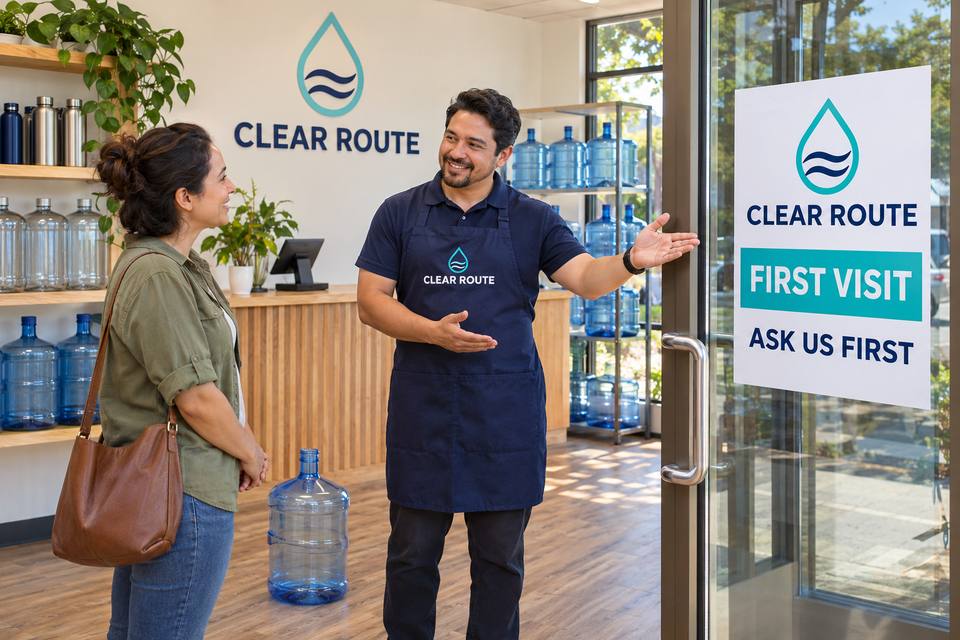
Why “I’ll just bring a jug” is not quite a plan
The frustrating part of a first visit can be the transaction rather than the water selection: Where does the empty go? Must you pay before taking a replacement? Does returning a bottle mean a refund? In a discussion about Primo exchange checkout, commenters describe confusion about those steps. The original post is deleted, and replies are individual experiences, not current retailer policy. Their useful lesson is to ask how the particular location processes an exchange before putting an empty into a return area.
You do not need to memorize every provider’s program. You need to identify which transaction you are making and what that location requires. Calling ahead with a bottle’s size and brand—or showing staff a photo before bringing several containers—can make the conversation much clearer.
Refill, exchange and delivery are different services
| Service | What happens to the container? | Confirm before the trip |
|---|---|---|
| Refill | Your container is filled, and you take that same container home. | Accepted bottle sizes and condition, machine clearance, cap and payment instructions. |
| Bottle exchange | An eligible empty is returned; you purchase a different, pre-filled bottle. | Eligibility, first-purchase versus exchange price, and how staff or the machine records the return. |
| Water delivery | A provider brings bottles under its own order and return arrangement. | Service area, quantity, delivery access, fees and any deposit or empty-return terms. |
For a concrete example, Primo’s May 2026 guide describes its refill option using personal 1-, 3- or 5-gallon bottles and its exchange option using empty 5-gallon bottles for pre-filled replacements. Those are that provider’s described formats, not proof that any bottle will fit any machine or qualify at any rack.
Its current exchange overview begins with buying a pre-filled bottle, then describes exchanging an empty for a discounted replacement. That distinction matters for a first-time customer who has no empty yet. Ask for the price of the transaction you can actually make today.
Six things to confirm before your first visit
- The exact service and location. Ask, “Is this a refill machine, a bottle-exchange rack, or a staffed refill counter?” Check that the service you want is available at that branch, rather than relying on a general store listing.
- Your container’s eligibility. Give its size, brand and condition. For a refill, ask whether that container fits the equipment and meets the operator’s requirements. For an exchange, ask whether that specific empty is accepted. A familiar gallon size alone does not settle eligibility.
- The cap and dispensing arrangement. Ask whether you need to bring a compatible cap or buy one, and check your home dispenser’s requirements. Do not assume a cap from another bottle or a bottle that looks similar will fit.
- Today’s complete transaction price. Separate the first purchase, refill and eligible-empty exchange. Ask about any container charge, refundable deposit or other fee, and what would make a return eligible. Do not compare an exchange price with a first-purchase price as if they include the same things.
- Hours and payment at the actual service point. Confirm whether the counter and outside machine operate at different times and whether each takes cash, cards or a particular account method. A store’s card acceptance does not automatically describe its outdoor machine.
- Where to start when you arrive. Ask whether to check in, get a ticket, pay at checkout or follow a machine’s on-screen process. Follow the current instructions before surrendering an empty; do not take a replacement on the assumption that returning a bottle has already paid for it.
The payment distinction is real: Fresh Alka Water’s first-visit FAQ describes card payment inside its San Diego store and cash for its outside vending machine. This is one shop’s arrangement, not a nationwide rule. Check your own destination’s current information.
A bottle return is not automatically a refundable deposit
People use “deposit,” “bottle charge” and “exchange discount” loosely, but the terms can describe different transactions. Ask what you pay on the first visit, what changes when you bring an eligible empty back, and whether you can receive money back without buying more water.
There is no single answer for every provider. Primo’s older program explanation explicitly distinguished its exchange arrangement from a refundable deposit; use the current operator’s terms rather than treating an old price or acceptance policy as today’s promise. Meanwhile, Verde Springs describes a refundable bottle deposit for its own Chicago delivery service. Delivery terms from that company do not establish the rules at a grocery-store exchange rack.
Two first visits, with different answers
Taylor has no bottle and wants a quick pre-filled purchase. Taylor sees an exchange price online and initially assumes an empty is required to buy anything. After calling the participating retailer, Taylor asks for the first-purchase option and total price without a return, confirms the bottle’s compatibility with the home dispenser, and follows that location’s checkout process. Taylor keeps the program’s return instructions for next time instead of expecting a cash refund merely because the bottle becomes empty.
Jordan wants to keep an existing three-gallon container. A bottle-exchange rack would not accomplish that goal. Jordan asks a staffed refill shop whether the particular container is suitable, what cap is needed and when staff are available to help on a first visit. The shop confirms its process, so Jordan chooses the refill counter during those hours. If it cannot accept the container, Jordan will choose a different container or service after asking—not leave the existing bottle in an exchange cage. These are fictional decision examples, not reports of purchases at a named retailer.
A ready-to-use question for the shop
“This will be my first visit. I have a three-gallon bottle that I want to keep, so I’m looking for a refill rather than an exchange. Can you accept that container, and what cap should I bring? I’ll be coming on Saturday afternoon. Will staff be available, what payment method should I use, and where should I check in before I start?”
If you want a pre-filled bottle instead, replace the first two sentences with: “I don’t have an empty bottle yet. Do you offer a first purchase, and what is the total price without an exchange?” This makes the transaction clear without assuming a particular retailer’s policy.
For water-store owners: put the first step at the entrance
Customers cannot follow a process they have not seen. A useful entrance message should say what service you offer and where a new visitor starts. Keep detailed eligibility, pricing and return terms at the service point, where staff can explain them. A short doorway message is a direction to that information, not a substitute for it.
Editable entrance-copy template
FIRST VISIT? PLEASE CHECK IN AT [COUNTER / SERVICE POINT].
We offer: [ACTUAL SERVICE].
Before starting: confirm your container, payment and return instructions with [STAFF / POSTED MACHINE DIRECTIONS].
Service hours and accepted payments: [CURRENT DETAILS OR WHERE TO FIND THEM].
Fill in only what is true at your location. If you run a refill counter but not an exchange program, do not advertise both. Put the same current instructions on your website. Plain printed paper is enough when the message changes frequently; custom printing is optional.
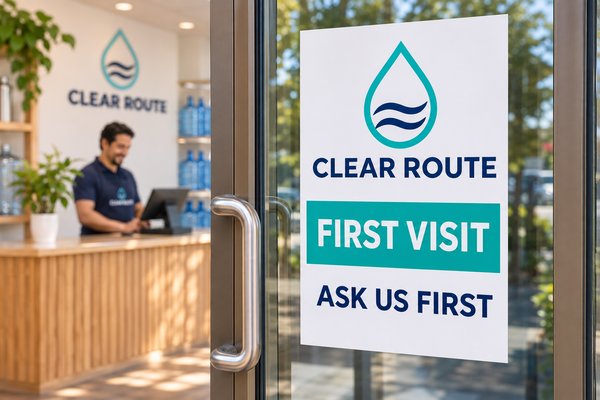
A small graphic with one clear job
Custom window clings for water stores can carry your logo and a short first-visit direction. DecentCustom lists SKU decentcustom-mm-000163 with white or clear material, background and glass-side options, including a 12 × 18-inch size. Confirm the selected material, viewing side and mounting specification before ordering; the product page uses mixed backing terminology.
Keep the lettering readable and clear of handles and essential visibility. The illustration does not establish adhesion, service life or water resistance, and the graphic says nothing about water quality. For other customer-facing print, explore custom marketing materials or custom products from DecentCustom.
First-visit questions, answered
Can I buy an exchange bottle if I do not have an empty?
Ask the participating retailer about a first purchase without a return. Some programs, including the first-purchase process described by Primo, provide that route. The price can differ from an eligible-empty exchange, so confirm the total rather than assuming the advertised exchange price applies.
Can I exchange another brand’s bottle?
Do not assume so. Give the current operator the bottle’s brand, size and condition and ask whether that exact container qualifies. A refill option and an exchange program may accept different containers, and an old online comment is not a current acceptance policy.
Will I get a deposit refund when I return the empty?
Only if your particular agreement provides one and you meet its conditions. A lower price when buying a replacement is different from a cash refund. Ask what happens if you return the empty without buying another bottle, and retain any required record.
Can I use the machine after the shop closes?
Check that location’s machine hours, availability, payment instructions and help options separately from the staffed store’s hours. If you need a new bottle, cap or explanation, a first visit while staff are present may be more useful than arriving at an outside machine after closing.
This guide addresses shopping and transaction planning. Follow the actual operator’s container, equipment and handling instructions; it does not evaluate water quality or provide cleaning, health or treatment advice.