
CRAFT BEER BOTTLE SHOPS · READ THE CODE BEFORE THE SHELF TALKER
A canned-on date and a best-by date answer different questions. The first tells you when beer was packaged; the second gives the producer’s intended freshness window. Before buying, identify which date you are reading, check the brewery’s guidance for that particular beer, and ask about storage. A recent delivery or a cold can does not, by itself, establish when it was packaged or how it was handled earlier.
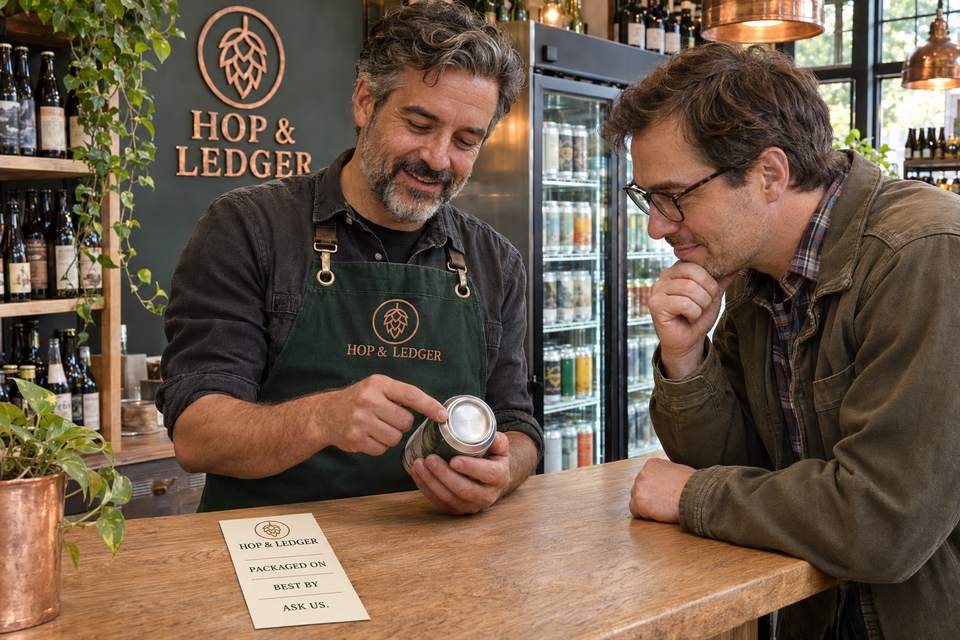
Why the date deserves a moment before checkout
Finding an unfamiliar IPA can be exciting. Finding out at home that the printed date meant something different is less satisfying. In a craft-beer discussion about checking dates, shoppers describe frustration with older cans, while a receiving worker describes efforts to control incoming inventory. These are individual reports, not a measure of how bottle shops generally operate. They do reveal a useful customer question: “Can someone help me understand this exact can?”
You do not need to become a code-decoding expert. You need enough information to decide whether this beer fits your plans. The distinction matters especially when buying hop-forward beer for its aroma, or buying a gift that will sit before it is opened.
Four date situations and what to do next
| What you find | What it tells you | Your next step |
|---|---|---|
| Canned, bottled or packaged on | The packaging date, rather than a universal deadline. | Check the producer’s freshness guidance for this beer and its storage conditions. |
| Best by or enjoy by | A producer’s date for the intended drinking experience. | Read it as that producer describes it; do not subtract a guessed number of months. |
| An unexplained string of numbers or letters | Possibly a date code, batch code or other production information. | Ask the shop or brewery to identify the code and its format. |
| No readable date on the individual can | You have an information gap. | Ask for help, check matching outer packaging with staff, or choose a clearly identified alternative. |
Firestone Walker’s own date explanation describes its packaging-date format and locations. That is useful precisely because it comes from the producer. It is not a decoder for every brewery’s cans. An ambiguous code should remain an unanswered question until the correct source explains it.
A five-step check that works in a bottle shop
- Choose for the person and the occasion. Start with the style they enjoy, whether beer would be welcome, and when it is likely to be opened. A gift for later needs a different conversation from a can for this weekend.
- Inspect the actual package you will buy. Look over the base, label and other printed surfaces. A shelf announcement that says “new arrival” describes a shop event, not necessarily a packaging date.
- Identify the date type before interpreting it. Look for the accompanying words. If the format is unclear, photograph the whole marking and ask staff. Do not assume every slash-separated date uses the same order.
- Ask about the specific beer and its history. What does its producer recommend? What storage information can the shop confirm, and what is unknown? A refrigerator is useful, but it cannot tell you the entire journey of that can.
- Buy for a realistic plan. If the information supports your intended timing, choose accordingly. If important details remain unclear, choosing another beer is reasonable. You do not have to buy a larger pack just because a release is unfamiliar or scarce.
MoreBeer’s discussion of retail beer freshness makes the storage-history limitation clear: beer sitting in a refrigerator now may previously have spent time elsewhere. Ask for what the seller actually knows, rather than treating the current shelf as proof of continuous refrigeration.
Why there is no single “fresh enough” number here
Style, packaging and storage conditions matter. Sierra Nevada’s freshness guide explains its own packaging dates and gives guidance tied to its beers and cold storage. Applying one producer’s time window to every IPA, lager and specialty release would remove that context.
Hop aroma can also change with time. Allagash’s explanation of beer aging discusses fading hop aromas and distinguishes the effects of heat and light. This supports checking freshness and handling; it does not establish a universal cutoff for every beer. Deliberate cellaring is a separate choice that needs guidance for the named release. A darker label, stronger beer or higher price is not enough to make that decision.
Two shoppers who should make different choices
Morgan wants a hop-forward IPA for the coming weekend. One can has an unexplained code. Another has a clear packaged-on date and producer guidance that the shop can explain. Morgan asks about the second can’s storage, accepts the details the staff can actually confirm, and chooses a small purchase for the planned occasion. Morgan passes on the ambiguous can instead of assuming the newly stocked shelf means newly packaged beer.
Quinn is choosing a gift that will be opened much later. Quinn initially picks the same IPA because the artwork looks distinctive. After explaining the timing, Quinn asks whether that specific release suits the plan. The shop cannot confirm that it does. Quinn changes the gift plan and arranges to choose a suitable beer closer to the occasion, rather than buying now and inventing a storage strategy. These are fictional shopping examples, not endorsements of particular beers.
A question you can use without sounding confrontational
“I’m looking for a hop-forward IPA for this weekend. Could you show me whether this marking is a packaging date or a best-by date, and explain the producer’s guidance for this beer? What do you know about its storage? If the code cannot be confirmed, is there a clearly dated alternative in a similar style?”
If something you already bought disappointed you, keep the package and its code, note where and when it was purchased, and contact the seller politely. Describe what happened and ask about their policy. A forum recommendation is not the shop’s return policy, and an internet diagnosis cannot establish what happened to your particular beer.
For shop owners: make the answer easy to find
A practical receiving and shelf routine can separate three records: what arrived today, what the producer’s code means, and where that batch has been stored. Keep batches distinguishable, review stock against the producer’s current guidance, and give staff a clear person to ask when a code is uncertain. Do not turn an arrival-date sticker into a replacement packaging date or obscure the original marking.
A short counter explanation can cover stable questions: “Packaged on or best by?”, “Ask us about this code” and “Tell us when you plan to open it.” Keep changing batch dates and product-specific instructions in the current inventory record. Existing paper or a digital note may be enough; branded print is optional.
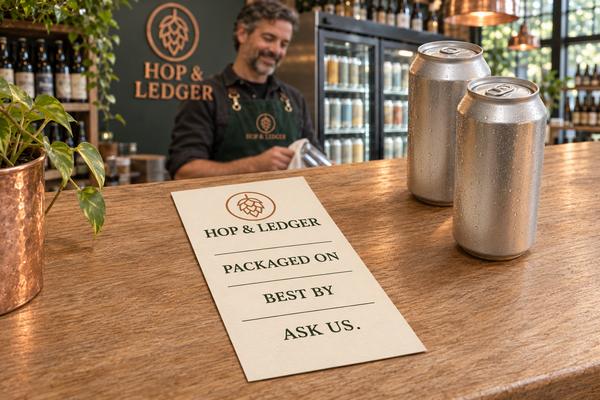
A take-home date explainer
For a consistent dry-counter handout, consider custom rack cards for bottle shops. This product lists a 3.74 × 8.27-inch size with standard 14pt stock and a glossy default; other listed stock and finish options should be checked for the chosen order.
This is a flat paper card, not a refrigerated shelf label, waterproof sign or freshness certification. Browse custom marketing materials for other shop communication formats, or explore custom products from DecentCustom for additional branding needs.
AI-generated product-and-shop illustration. The depicted card layout is a concept, not a print proof. Beer cans are props; no display stand is included or implied.
Bottle-shop questions, answered
Is the date on the bottom of a beer can its expiration date?
Not necessarily. It may be a packaging date, a best-by date or a production code. Look for the wording and confirm the producer’s format. Do not decide from the location alone.
Does a cold can prove the beer has always been refrigerated?
No. It shows the current condition, not the full storage history. Ask what the shop can confirm. Treat unknown handling as unknown instead of filling in a reassuring story.
What should I do if I cannot read the beer’s date code?
Ask staff to help identify it, using the complete marking and exact beer name. A matching case or the producer may clarify it. If you cannot establish the information you need, choose a clearly identified alternative.
Should I buy an older beer to cellar as a gift?
Only consider intentional aging with guidance for that specific release and a suitable storage plan. Do not use an older date, dark color or higher price as proof that a beer is designed for cellaring. For a later gift, buying closer to the occasion can be a simpler plan.
Research checked November 14, 2026. An adult retail buying and communication guide; it does not assess the safety, condition or availability of any particular beer.