
Fish and seafood markets · Keep the preparation matched to your meal
You want to put a whole fish on the table. At the counter, you ask for it “cleaned.” Before the fishmonger begins, add the detail that matters most: you want the body left whole. Gutting, scaling, removing the head and cutting fillets are separate choices.
State the final form first: whole fish, head on or off, or fillets. Then say what you want removed or kept. For a whole-fish presentation, a clear request is: “Please gut and scale it, remove the gills, keep the head and tail on, and leave it whole—not filleted.” Ask whether the shop offers that preparation and have the employee repeat it back before starting.
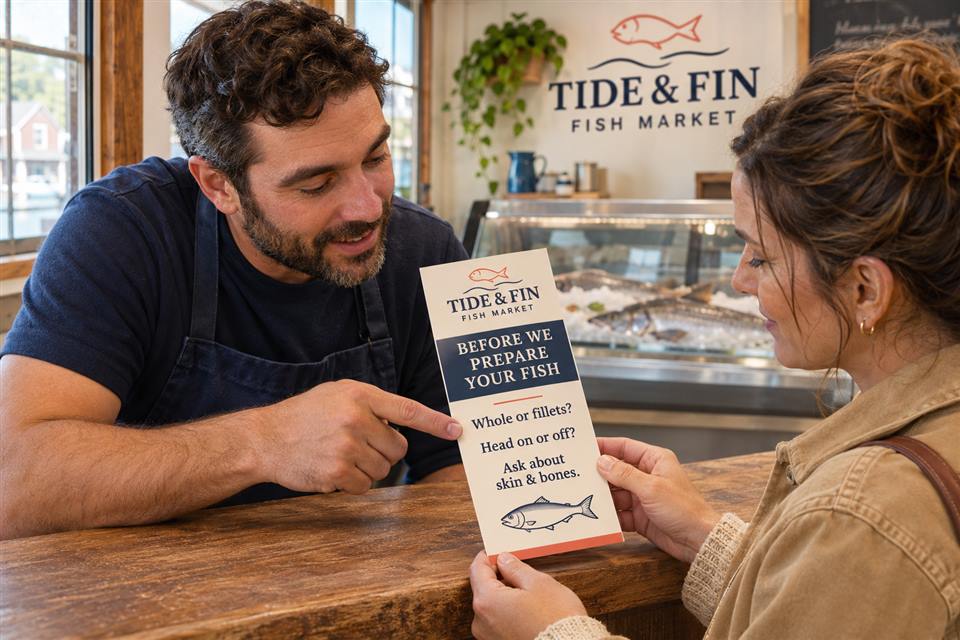
The missing detail may be what you want left intact
In a July 2021 discussion about buying a whole fish, a shopper asks for a branzino gutted and descaled but struggles to understand the counter employee’s follow-up question. The shopper leaves without the preparation being resolved.
The post later acknowledges a possible misunderstanding between “gut it” and “cut it.” We cannot verify the exchange or infer a retailer’s policy from it. The useful lesson is the need to describe the finished form clearly. Saying what stays—whole body, head on, tail on—can resolve a different question from saying what comes out.
Tell the fishmonger the planned presentation. “I want to roast and serve it whole” supplies useful context without requiring you to know every trade term. The Institute of Culinary Education’s fish-buying guide likewise emphasizes discussing the purchase with the fishmonger and considering the available cuts.
What the preparation words do—and do not—specify
North Carolina Sea Grant’s market-form guide separates whole, drawn, dressed, fillet and steak forms. In ordinary counter conversation, use those words as a starting point, then clarify the result:
- Gutted: The internal organs are removed. That does not, by itself, say that the scales or head have been removed.
- Scaled or descaled: The scales are removed. Say separately whether the skin should remain.
- Head on or head off: State the choice directly if the appearance of the whole fish matters to you.
- Filleted: The flesh is cut away from the backbone. Specify skin on or off and ask about pin-bone removal.
- Left whole: Make clear that you do not want the body divided into fillets or cross-cut pieces.
“Dressed” needs particular care. The Sea Grant guide describes dressed fish as usually having the head, tail and fins removed. The Culinary Institute of America’s fish-buying cheat sheet says the head may or may not be removed. Rather than settle a vocabulary argument at the counter, ask what that shop means by the term and specify whether you want the head retained.
Also ask what has already been done to the fish on display. If it is already gutted, the remaining request may be scaling and a decision about the head or fins. If a requested preparation is not available, clarify the alternatives before approving one. Do not assume every market offers the same service, fee or turnaround.
Skin and pin bones are separate questions
A fillet can be skin-on or skinless. It may also need a separate pin-boning step. Harbor Fish Market’s FAQ explains that bones can remain in fillets and defines PBO as “pin bones out.” Its staff inspect their fillets, but the market still advises that bones can be present.
Ask what bone-removal work the shop can perform on that particular fish. Avoid treating the word “fillet,” a diagram or a printed counter promise as a guarantee that no bone remains. This guide helps clarify the purchase; it is not a bone-removal or food-safety procedure.
Two clear requests, with the readback that completes them
These are fictional examples of how to describe a preference. The shop must confirm the preparation it can actually provide.
1. A whole fish with its head and tail retained
Shopper: “I want to serve this fish whole. Please gut and scale it and remove the gills. Keep the head and tail on, and do not fillet it. Can you prepare it that way?”
Useful employee readback: “The body stays whole, with the head and tail on. You want the guts, gills and scales removed, with no filleting. Let’s confirm what preparation is still needed on this fish.”
One remaining detail: If fins or other trimming matter to your presentation, agree on them now. Do not leave “cleaned” to carry those extra instructions.
2. Fillets with the skin retained
Shopper: “I would like fillets with the skin left on, not a whole fish. Could you check for pin bones and tell me what removal you offer? Please leave the fillets intact rather than cutting individual portions.”
Useful employee readback: “You want skin-on fillets, left as fillets rather than portioned. We’ll clarify the pin-bone preparation we can provide for this fish.”
The words about skin and bones answer different questions. Confirm both instead of assuming one follows automatically from the other.
If the shop cannot provide the requested result: Ask what form is available. Decide whether that works for your meal before work starts, or choose another product. If you are not sure what an alternative means, ask the employee to describe what you will receive. A different cut can change the presentation you had planned.
Common whole-fish preparation questions
Does gutted mean the fish has also been scaled?
No. Gutting concerns the internal organs; scaling concerns the outside scales. Ask what has already been done and what remains to be prepared. If you want the fish kept whole, state that as well.
Does dressed fish always have the head removed?
Do not assume it does. The guides above describe that term differently. Ask the market what its preparation includes, then explicitly request head on or head off according to your intended presentation.
Are fish fillets automatically free of bones?
No. Ask about the preparation of that product, including whether pin bones have been removed. Even a fillet prepared with bone removal in mind can contain a remaining bone; the name of the cut alone is not a guarantee.
A printed prompt can support the conversation
For a seafood-market owner, the useful prompt is short: “Whole or fillets? Head on or off? Ask about skin and bones.” Staff can point to it while confirming the customer’s preference. A plain note, a simple drawing or a verbal readback may already do the job.
When a shop wants a consistent branded handout, a rack card offers space for a few clear questions. Keep general prompts on the card and explain the actual services separately. It should not promise every preparation on every species, free cutting, a bone-free result or food certification.
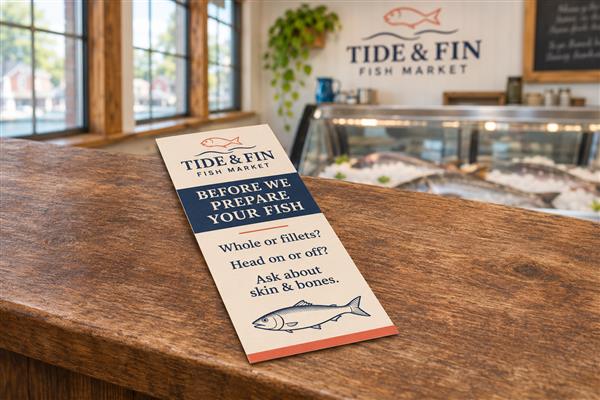
A narrow card for a few useful questions
DecentCustom’s custom rack cards list a 3.74 × 8.27-inch size and full-color printing. The page specifies 14pt standard cardstock as the default and a 16pt premium option, with finish choices that depend on the stock.
Confirm the stock-and-finish combination, artwork and order quantity. This concept has a matte appearance; Glossy is the listed default. Review the text at its finished size and keep the main questions easy to read. The product is a flat printed card, not a folded sign, holder, food wrapper or waterproof counter item.
Compare related custom marketing materials for your counter, or explore custom products from DecentCustom after choosing the information you want customers to remember.
Before preparation begins, the customer and employee should be able to describe the same finished fish: what stays, what is removed and whether the body remains whole. That agreement is the purpose of the prompt.