
WHOLESALE FOOD PICKUP · MAKE THE QUANTITY UNAMBIGUOUS
Before a wholesale food pickup, record the exact item, the unit you ordered, what that unit contains and the total you expect to receive. “Pasta — 2” is incomplete. “Two cases, each containing six 2-pound bags; twelve bags total” gives the person collecting it something specific to verify.
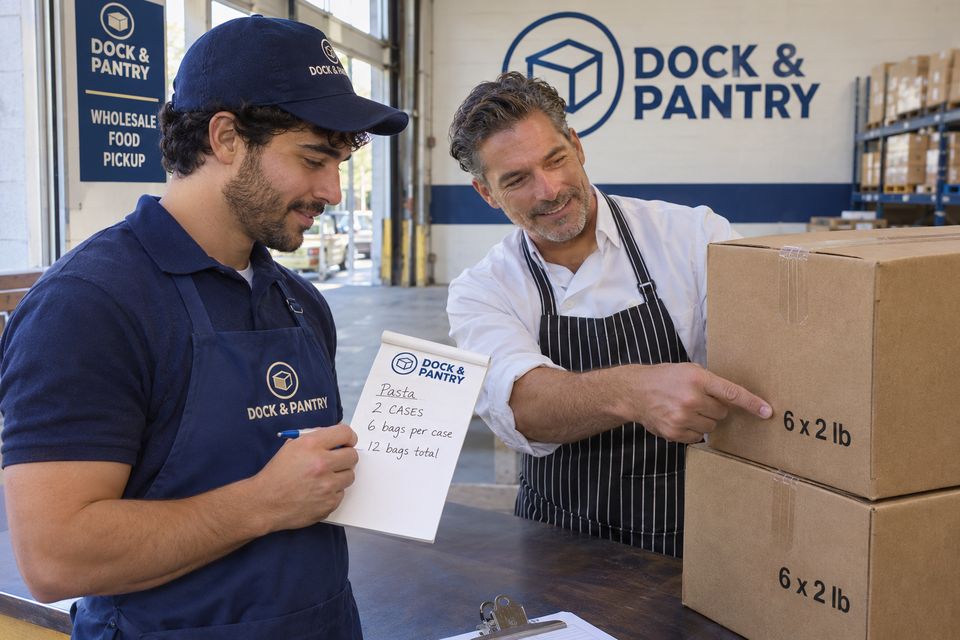
When another person makes the supply run, a shorthand shopping list can lose the detail the buyer had in mind. A case, an inner bag and a pound are different units. Confirming the unit before collection is more useful than discovering the disagreement after the order reaches the kitchen.
Why “one” needs a noun
In a KitchenConfidential discussion about food-order mistakes, kitchen workers described mix-ups involving cases, individual items and quantities. These are anecdotes, not an error-rate study or proof that a particular supplier is unreliable. They do reveal a question worth answering on every handoff: one of what?
The OneStop SupplyCo case-pack guide distinguishes outer cases, inner packs and individual counts. Apply that packaging distinction to your food order, while checking the actual supplier’s terminology. A listing’s numbers are useful only when you know what each number describes.
Four fields to confirm before sending someone to collect
| Field | Write it clearly | Resolve this ambiguity |
|---|---|---|
| Exact item | Full product name, brand or specification, and supplier item number where available. | A similar name or package should not silently become an approved substitute. |
| Selling unit | Case, individual bag, bottle, each, or another expressly stated unit. | The number in the quantity box does not explain the unit by itself. |
| Contents of that unit | For example, six bags per case and two pounds per bag, if confirmed for that item. | Do not assume the first number in an unfamiliar pack notation is the number of cases. |
| Expected total | Number of cases and inner packs; total labeled weight where relevant. | Make the collector’s physical count comparable with the order. |
If the description is unclear, ask the seller to spell out the pack. A carton photograph may help, but it should not overrule the current item specification or an unresolved difference on the order.
Wholesale does not always mean “case only”
Jetro’s company information says most stocked items are sold by the case and directs buyers to shelf labels for descriptions, sizes, selling units and prices. It also tells shoppers to ask for help when unsure about a package.
By comparison, the CHEF’STORE FAQ says it sells both individual items and bulk or case quantities. The useful rule is to check the specific item and location, rather than announcing that every foodservice warehouse requires a full case. If you need two individual bags, ask whether that exact product can be purchased that way.
Worked example: two cases are not two bags
Hypothetical order: Jordan’s café needs twelve bags of a particular dry pasta. The supplier confirms that one case contains six bags, each labeled 2 lb. The seller’s order quantity is expressed in cases.
Jordan orders 2 cases × 6 bags per case = 12 bags. The labeled product weight is 12 bags × 2 lb per bag = 24 lb. That is the pasta weight described by the pack, not the shipping weight of cartons and packaging.
If Jordan entered “12” in that case-based quantity field, the order would instead be twelve cases: 12 × 6 = 72 bags, containing 144 lb of labeled product. The arithmetic is simple; the important step is identifying the selling unit before entering the number.
Suppose only one case is available when the order is prepared. That is six bags, not a completed twelve-bag order. The collector contacts Jordan to decide whether to take the partial quantity, choose a specifically approved alternative or change the plan. The example does not assume the retailer permits broken cases, substitutions or a particular refund process.
An order acknowledgment is not always a ready message
Read the message that describes the prepared order. CHEF’STORE’s Click&Carry information, for example, describes a confirmation when the order is filled and says the final email identifies unfilled items. It also notes that cutoffs and pickup times vary by location. Use the current instructions for your chosen store and service; do not transfer one chain’s process to another.
Before the trip, the buyer and collector should agree on the store, collection window, order reference, missing-item message and who can approve a change. If any of those is unresolved, clarify it before treating the list as a ready-to-load order.
A complete pickup handoff you can adapt
Fictional café pickup note
Buyer: Jordan, café manager. Collector: Lee.
Store: North warehouse, pickup desk. Order reference: EXAMPLE-214.
Item: the confirmed dry pasta item shown on the attached supplier order.
Collect: 2 CASES. Each case: 6 bags × 2 lb. Expected total: 12 bags / 24 lb of labeled pasta.
Before leaving: check the store’s ready message and any unfilled lines.
If quantity, item or pack differs: call Jordan before approving a change. Record what was actually collected.
This example deliberately writes out the unit instead of relying on “2 × pasta.” Attach the exact current supplier line or item photograph to the real handoff; a generic note should not replace the actual order identity. Keep the buyer’s real contact information in your team’s normal private channel.
For pickup teams: make the note easy to carry
A shared digital list may be enough. A short handwritten note is also useful when a collector needs to compare a carton with a quantity without switching between several screens. Use the same fields each time and record differences when they occur.
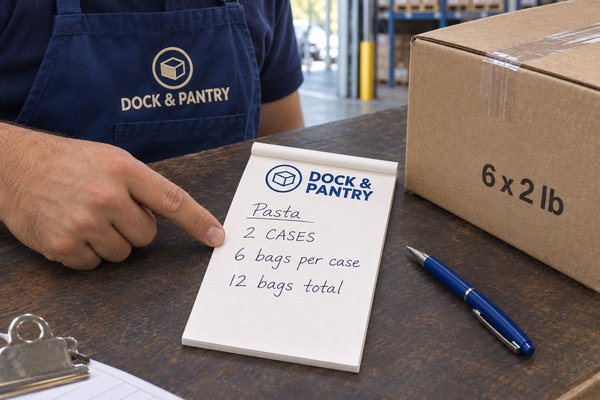
A small paper aid for a clear handoff
Custom notepads for wholesale pickup teams can carry the shop logo above a handwritten order note. The linked product is a 4-inch-wide × 6-inch-high paper pad with 25 blank sheets and a sticky top behind. The example shows handwriting on a blank body, not an included printed order form.
Confirm artwork and order options before printing. Keep the paper on a dry desk or with the collector’s paperwork; it is not a food label or a replacement for the supplier’s receipt.
Browse custom office and stationery products for other team materials, or explore custom products from DecentCustom. The goal is a readable handoff, whether you use a branded pad, ordinary paper or your existing digital system.
Frequently asked questions
What is the difference between a case and a unit?
A case is usually an outer carton containing smaller packs or items. “Unit” can describe the item being sold, which may itself be a case. Confirm the seller’s definition and the contents of that selling unit for the exact product.
Can I buy just one bag at a wholesale food store?
It depends on the item and store. CHEF’STORE describes both individual and case purchases, while Jetro says most stocked items are sold by the case. Ask about the current product rather than assuming every case can be opened for individual sales.
Does an online order confirmation mean it is ready?
Check whether the message acknowledges your request or confirms the prepared order is ready. Read any unfilled-item information and follow that store’s current pickup instructions.
What should I give the person collecting my order?
Share the exact store, order reference, current item details, selling units, expected contents and the agreed way to resolve differences. Include any collection requirements the store has given you and the buyer’s private contact route.