
PLANT-BASED GROCERY · CHOOSE FOR YOUR DISH
Choose vegan cheese by what you want it to do: spread on crackers, slice for a sandwich, crumble over a dish, or melt during cooking. Then check the exact product’s current serving suggestions and preparation instructions. A familiar flavor name, a plant-based ingredient or a packet of shreds does not tell you how every product will behave.
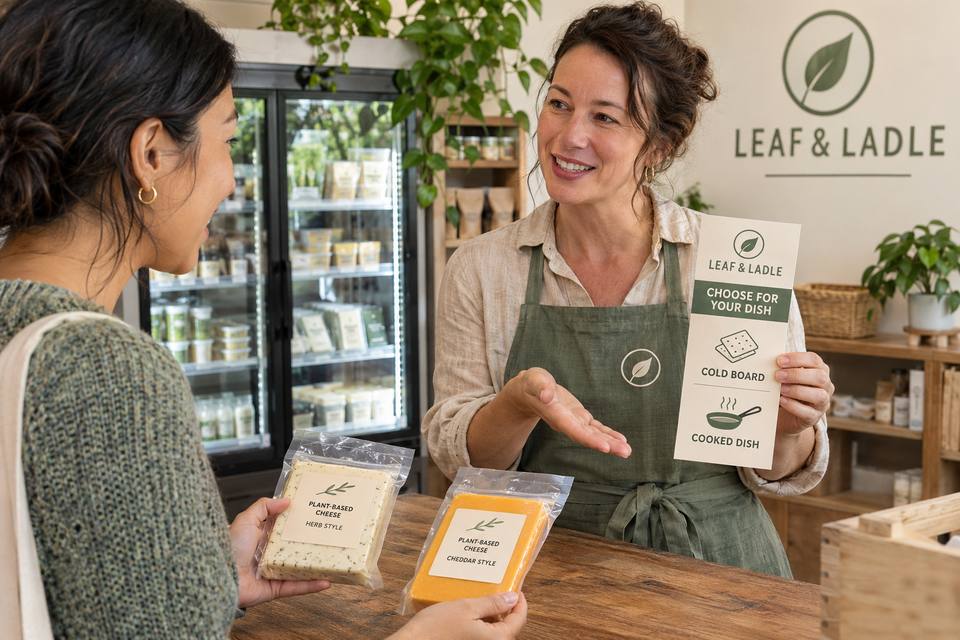
A holiday board and a hot sandwich may both need something described as cheddar-style. Yet one purchase is about a bite you enjoy cold; the other is about the result after heating. Starting with that distinction makes the conversation at a plant-based grocery much more useful than asking which brand is simply “best.”
Why the cold-versus-melted question matters
In a Reddit discussion about vegan cheese for cold crackers, the original poster wanted a product they would enjoy without melting it first. Replies recommended different styles and also disagreed about particular products. Those are personal preferences, not a taste ranking or evidence that everyone dislikes the same cheese.
The BetterFoodGuru guide to vegan cheese similarly organizes part of its advice around uses such as boards and melting. Use that question-led approach, then verify a recommendation against the exact product. This article does not report our own tasting trial or promise an identical dairy-cheese experience.
Match the job before choosing the pack
| Your dish | The result you want | What to check before buying |
|---|---|---|
| Crackers or a cold board | A spreadable, sliceable or crumbly bite you want to eat as served. | The exact product’s cold-serving suggestions and texture description. Do not use a melting claim as your only reason to choose it. |
| A cold sandwich | A convenient layer or spread that fits the bread and filling. | Whether the maker describes that product for sandwiches; decide whether you want a slice or a spread. |
| A hot sandwich or burger | A product intended to soften or melt in the planned dish. | That specific product’s application and cooking directions. A cold-serving recommendation alone does not establish the heated result. |
| Pizza or a cooked sauce | A topping or addition suited to that preparation. | Whether cooking is required, how the maker says to use it, and whether your planned method fits those directions. |
These are shopping questions, not four fixed categories of cheese. A product may suit more than one job. Check the current package rather than assuming all products from the same brand share one formulation or set of instructions.
Three manufacturer examples that keep the advice specific
Treeline’s French-Style Cashew Cheese page suggests crackers and vegetables, as well as uses including sandwiches and stirring into pasta. That is a useful counterexample to a rigid rule that a spread can only belong on a cold board. It does not mean every spread will behave the same way in a hot dish. The page also says its online shop is unavailable; check your local store for the actual item rather than treating a serving suggestion as an availability promise.
The U.S. page for Violife Just Like Cheddar Slices discusses sandwiches and melting a slice on a burger. That is product-specific guidance to investigate for those jobs, not a guarantee that every vegan slice melts alike.
Miyoko’s Pourable Mozzarella FAQ describes a product that needs cooking to set. Its liquid form is therefore not a reason to assume it is a ready-to-serve cold cheese sauce. Read and follow the current instructions for the exact product you buy.
The lesson is to connect a named item to a named use. An ingredient such as cashew or coconut, a hard or soft appearance, or a flavor word such as smoked cannot replace that check.
A worked shopping example: one board, one hot dinner
Fictional scenario: Maya wants crackers with a savory spread for a small holiday visit and cheese for a pizza later in the week. Her first idea is to buy one package with a mozzarella-style name and use it for both.
At the store she compares two hypothetical current packs. Option A is an herb spread whose serving suggestions include crackers. Option B is a pourable pizza topping whose instructions require cooking. Maya chooses A for the crackers because that is the stated application. She considers B separately for the pizza, after reading its directions and checking that she can follow them.
She does not pour B over the cold board merely because it comes in a bottle. She also does not conclude that A can never be used in cooking: if she later wants it for pasta, she will check that exact product’s guidance. If she only needs the board, she buys for that job instead of adding a second product just to complete a set.
This is a decision example, not a claim about a retailer’s stock or a recipe we tested. It shows why writing down two intended dishes can prevent one vague “vegan cheese” purchase from having to solve two different problems.
A specific question to ask the grocery store
“I want a savory spread for cold crackers, with no cooking step for that serving. Which current product is described for that use? Please show me the full product name, the serving suggestions and the current pack. Separately, I’m considering a pizza topping: does this exact one require cooking, and where are its preparation directions?”
That gives the seller a task they can answer from the product information. If taste is your uncertainty, ask how the maker describes the flavor and whether the shop can explain its recommendation. A staff preference can be helpful when identified as a preference; it should not become a promise that you will like the same thing.
For plant-based shops: put the buying question on a small guide
A clear use-case guide can start the conversation without pretending to replace the package. Keep its message short enough to scan, and point customers to staff for the current item.
LEAF & LADLE — CHOOSE FOR YOUR DISH
Cold crackers or a cooked meal?
Tell us the dish and the texture you want.
We’ll help you find the current product’s serving suggestions and preparation directions.
Check the exact pack before choosing.
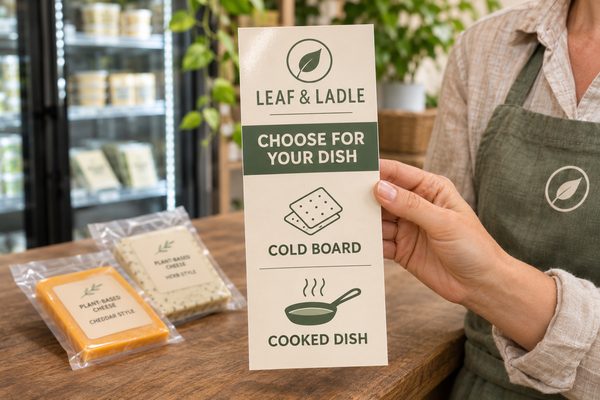
A printed guide customers can take away
Custom rack cards for plant-based grocery stores offer a compact format for a shop logo and this conversation prompt. The linked paper card is listed at 3.74 × 8.27 inches, with 14pt Standard and Glossy as default options. Confirm your artwork and selected options for the order.
The illustration shows a flat printed paper card; a display holder is not included in that product description. Keep it on a dry retail surface and separate from unpackaged food. A handwritten version can do the same communication job before you decide to print a run.
For a coordinated shop guide, explore custom marketing materials for grocery stores or browse custom products from DecentCustom. Printing is optional; useful, accurate wording comes first.
Frequently asked questions
Does all vegan cheese melt?
Do not assume so. Look for the exact product’s intended use and current preparation directions. Even when a maker describes a product for melting, that does not guarantee the same result across every dish or cooking method.
Can I use a cheese spread in a cooked dish?
Possibly. Treeline’s French-Style page, for example, includes stirring its product into pasta among its serving ideas. Check your specific spread’s instructions; spreadable texture alone neither rules cooking in nor rules it out.
Is a pourable mozzarella suitable for a cold board?
Its bottle format is not enough to decide. The Miyoko’s product discussed here requires cooking to set. For cold crackers, choose an item whose current information supports that serving instead of assuming a pourable product is ready for it.
Which vegan cheese brand should I try first?
Start with one dish and the texture you want, then compare exact products described for that job. Flavor preferences differ. A recommendation is more useful when it names the product, the intended use and whether it is a personal preference or manufacturer guidance.