
FERMENTED FOOD SHOPS · THREE QUESTIONS FOR THE SAME JAR
Fermented pickles develop through microbial activity; vinegar-pickled vegetables get added acidity from vinegar. But an ingredient list or a refrigerated shelf alone cannot reliably classify every commercial product. Ask three separate questions: was this vegetable product fermented, what does the maker say about live cultures in the finished product, and how does the package say to store it? Some products combine a fermentation step with vinegar or vinegar-containing ingredients.
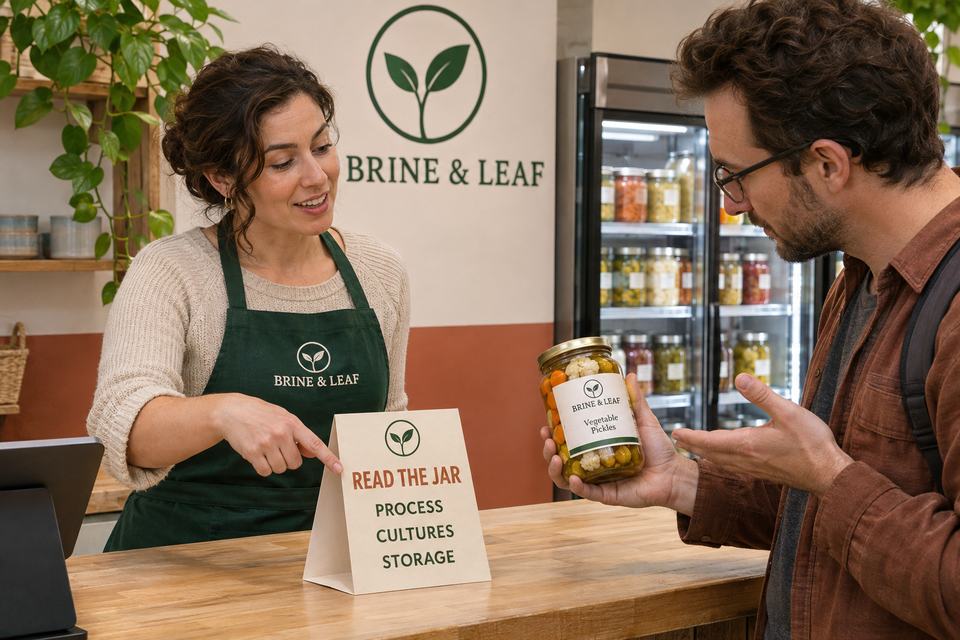
Keep the process, cultures and storage questions separate
These questions are easy to collapse into one. A customer sees a jar in a refrigerator, reads “pickles,” and assumes it is a live fermented food. Another sees vinegar in the ingredients and rules out fermentation immediately. Both shortcuts can fail.
The distinction between making a food and what remains in it matters. ISAPP’s explanation by food scientist Maria Marco describes fermentation as a microbial transformation of food. It also explains that a fermented food need not retain living microbes when eaten, and that live cultures are not automatically probiotics. The latter term requires more specific evidence about the microorganisms and their benefit. A shopping guide should not turn “fermented” into a promise of a particular health outcome.
This is a guide to choosing and understanding commercially packaged products. Start with the current package and the maker’s information for that exact item. Flavor, cut size and intended use still matter; you can enjoy a vinegar pickle without expecting it to be something else.
What common clues do—and do not—tell you
| Clue you notice | Useful information | What it cannot settle alone |
|---|---|---|
| The maker says the vegetables are fermented | A statement about the production process for that product. | Whether living cultures remain in the finished jar, or a particular health effect. |
| Vinegar appears in the ingredients | Vinegar is part of the listed formulation or a component ingredient. | That no fermentation step occurred. |
| The product is sold refrigerated | A reason to read and follow its storage directions. | That it is fermented or contains live cultures. |
| The maker describes live cultures | A separate statement to check for the finished product. | A standardized count, identified strain or demonstrated benefit unless those are supported separately. |
An ingredient list describes ingredients; it is not necessarily a complete processing history. Equally, a production description does not replace storage directions. If the label does not answer the question you care about, the honest classification is “not yet confirmed,” not a confident guess from appearance.
Three producer examples that break the shortcuts
1. Cold does not automatically mean fermented
Grillo’s own FAQ says its pickles use a fresh vinegar-pickling process and do not go through fermentation. The company also says they are made, shipped and sold cold. This is a concrete counterexample to “everything in the refrigerated pickle section is fermented.” It is a description of that maker’s process, not a judgment that one kind of pickle tastes better.
2. A fermented product can list vinegar from another ingredient
Bubbies explains why vinegar appears in certain spicy products: the vinegar comes from the pickled peppers used in its Spicy Kosher Dills and Spicy Sauerkraut, rather than its fermentation process. Reading only the word “vinegar” would miss that explanation. Check the particular product; do not extend the answer to every jar carrying the brand name.
3. A producer can describe both vinegar brine and a fermentation step
Cleveland Kitchen’s FAQ describes its pickles as made with vinegar brine and a proprietary lightly fermented process. That is another reason a yes-or-no vinegar test is too simple. The useful next question is how the maker describes that exact product, rather than assuming all commercial pickles fit two perfectly separate boxes.
These examples are included to test label-reading rules. They are not a ranking, a taste comparison, a laboratory culture count or an endorsement of each brand’s wider marketing claims.
A three-step jar audit you can use in the shop
- Identify the exact product and its process statement. Read the variety name, not just the brand. Look for the producer’s explanation of fermentation, fresh vinegar pickling or a combination. If you are comparing a spicy variety with a plain one, read both rather than transferring the plain jar’s description.
- Check culture information as a separate question. If live cultures are part of your shopping preference, look for a statement about that finished product and ask the maker when it is unclear. Do not convert a “raw,” “traditional” or “fermented” description into an assumed count or benefit.
- Read the package directions and choose for your actual use. Check storage instructions, date markings, ingredients, flavor and format. Compare chips for sandwiches, spears for serving alongside a meal, or shredded vegetables for a topping according to what you want to eat. Follow that package’s directions during transport and at home; another brand’s instructions are not a substitute.
A shopping note can be as simple as: Exact item → process confirmed? → culture statement? → storage directions? → intended meal. It is fine to leave a field unanswered until the producer clarifies it. A staff member saying “we are not sure; let’s check” is more helpful than an unsupported certainty.
Two jars, two different readings
Jar A is refrigerated and lists cucumber, vinegar, salt and seasonings. That tells you its listed ingredients and where you found it. It does not, by itself, confirm a fermentation step or live cultures. You check the maker’s current description. If it explicitly describes a non-fermented fresh-pickling process, you have an answer about the process. You may still choose it because you want that flavor and cut for sandwiches.
Jar B is described by its maker as fermented, but vinegar also appears on the label. Instead of rejecting it automatically, you ask whether vinegar is added to the vegetable brine, comes from another ingredient, or is used alongside a fermentation step. You check the separate culture statement and storage directions. If the maker does not explain the detail you need, you keep it unconfirmed and choose another clearly documented product if that criterion matters to you. These are fictional label-reading situations, not descriptions of tested jars.
A precise question for a producer or store
“I’m comparing this exact spicy vegetable variety with your plain one. Is the vegetable product fermented, vinegar-pickled, or made with both steps? The ingredient list includes vinegar—what role does it play here? Does your finished-product information state that live cultures remain, and where can I find the storage directions for this item?”
Customers do ask these questions. In a discussion about supermarket pickle labels, a UK shopper could not find clear processing information on a jar. That older conversation reflects an identification problem, not current US availability or scientific verification. Use the maker’s current answer rather than relying on a stranger’s guess about an unfamiliar brand.
For specialty shops: explain the three questions at the counter
A compact counter guide can help staff start the conversation without crowding product labels. Keep it general; put product-specific answers in the maker’s information or a maintained reference sheet. Update the explanation when your assortment changes.
Suggested counter-guide copy
READ THE JAR
PROCESS — What does the maker say about fermentation or vinegar pickling?
CULTURES — What is stated for this finished product?
STORAGE — Follow this package’s directions.
Unsure? Ask us to help find the producer’s information.
A plain paper note and a well-prepared member of staff may be all a small shop needs. Branded print is useful when the same explanation comes up repeatedly. Keep the note separate from individual ingredient and storage labels, and avoid turning a general category sign into a product-specific culture claim.
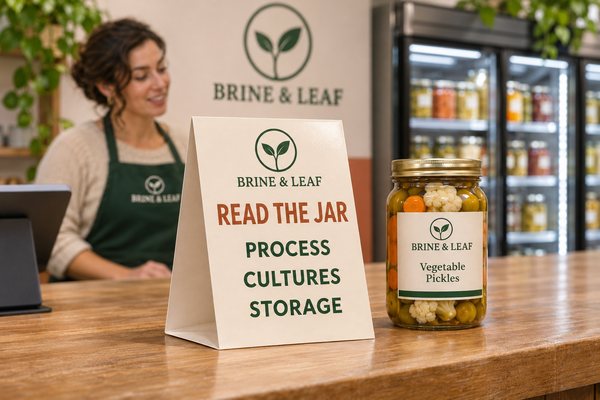
A small explainer where questions happen
A shop can use custom table tents for specialty food shops for a short branded explanation. DecentCustom lists SKU decentcustom-mm-000008 as a 5 × 7-inch table tent on 14pt card stock, with glossy finish as the default and matte as an option. The folded paper format stands without a separate holder.
Use it on a dry counter, separate from exposed food. It is not a refrigerated-case label or evidence about a jar’s contents. For related retail print, explore custom marketing materials or custom products from DecentCustom.
Pickle-label questions, answered
Are all refrigerated pickles fermented?
No. Grillo’s describes a non-fermented, vinegar-based fresh-pickling process for products that are sold cold. A refrigerator tells you where the retailer keeps the product; read the actual maker’s processing information and package storage directions.
Does vinegar in the ingredients mean the product is not fermented?
Not always. Vinegar may come from a component ingredient, as Bubbies explains for certain spicy products, or appear alongside a fermentation step, as Cleveland Kitchen describes. Check the exact variety and its maker’s explanation instead of using vinegar as an automatic exclusion rule.
Does fermented mean live cultures or probiotics?
Those are separate questions. A food can be fermented and then processed so that living microbes do not remain. A live-culture statement is also different from evidence for a specific probiotic. Read the finished-product information and avoid assuming a particular health benefit from the category name.
Can cloudy brine prove that a jar is fermented?
Use the maker’s explanation for that product rather than treating cloudiness as proof of a production process, live-culture count or food condition. If information is missing or you have a concern about a particular jar, ask the producer or retailer; this shopping guide cannot assess the jar from its appearance.